Supplements can be sold to consumers in mainland China without health food registration. The workable channel is customs supervision mode 1210, the bonded e-commerce route opened by Announcement No. 486 of 2018 issued by six departments including the Ministry of Commerce. Three conditions have to hold at the same time: the tariff code of your product is on the cross-border e-commerce retail import positive list, the buyer is an individual purchasing for personal use, and the order value stays within the statutory limits. When all three hold, the route is compliant from day one. When any one of them fails, stop at the diagnostic stage and do not force the entry.
This guide covers the whole route: what mode 1210 is, whether your product qualifies, how the 9.1 percent consolidated tax and the consumer quota work, what the fourteen work packages deliver, and how the three-step entry runs with clean exits at every stage.
What Mode 1210 actually is
China Customs writes every clearance channel into a four digit supervision code. Code 1210 is officially named bonded e-commerce retail import. The word import in the code name describes the movement of goods into a bonded warehouse inside Chinese customs territory; from your side nothing changes in direction, because you ship out of your home market and your buyers order from inside China. Announcement No. 486 of 2018 is the founding document: goods sold through this route are supervised as articles for personal use entering the territory, which is why the first-import licence, registration and filing requirements that ordinary trade imposes do not apply here.
Operationally the goods sit in a bonded warehouse inside a customs special supervision zone while they remain unsold, with no import duties paid at stocking. When a consumer orders, the platform pushes three documents to customs: the order, the payment and the logistics record. Customs matches the three and releases the parcel order by order, and the platform withholds the consumer-side tax at checkout.
What the full program covers
The service behind this route is organized into nine modules, numbered from 01 to 09, each solving one class of problem.
- Module 01 conclusions and advice: every conclusion comes first, the three launch decisions sit in one place.
- Module 02 entry: classification, tax, quota and route, each verifiable against a document.
- Module 03 keeping the downside safe: model restructuring, claim red lines and data compliance, legal basis plus system traces.
- Module 04 clean funds: fund segregation, three-stage settlement and remittance, the money path written down.
- Module 05 running it: the seven-flow backbone and the pilot modules S0 to S5, expanded cell by cell.
- Module 06 preparing growth: scale-up operations across S6 to S13, with acquisition, after-sales and membership detailed one by one.
- Module 07 clear numbers: schedule ranges, cost structure and calculation tools, with the parameters delivered alongside the program.
- Module 08 protection in place: liability assigned item by item, assets entirely yours, an exit that has been rehearsed.
- Module 09 starting the launch: a six-stage roadmap, seven preparations and a 30/60/90 day rhythm.

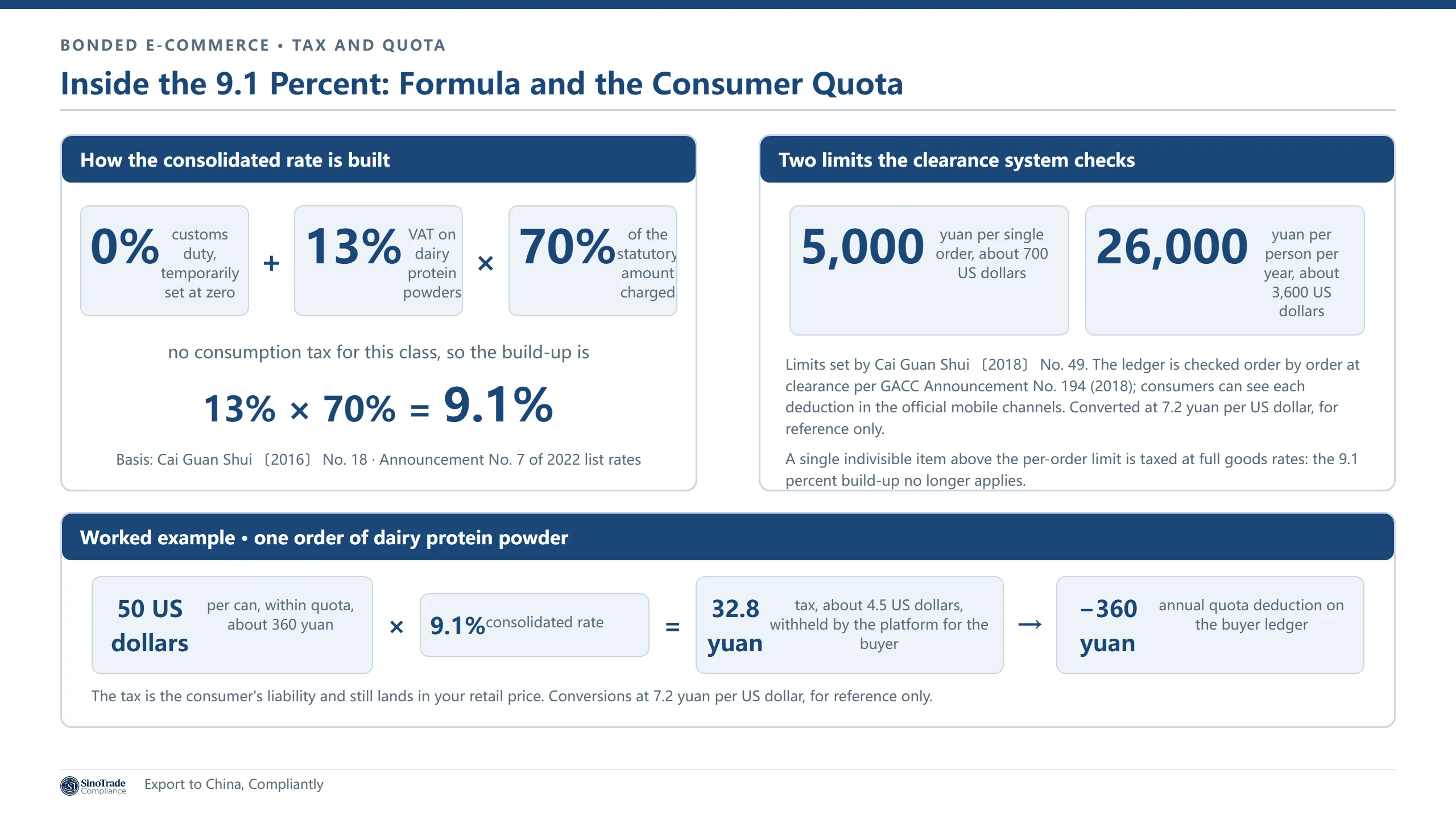
Buyers of the program usually arrive with four questions:
- The decision answer: a one-line conclusion, schedule, cost and return, and the decision timeline.
- The compliance basis: the regulatory constants and document numbers, the three exemptions and the three red lines, and the liability assignment.
- The cost and return: unit economics, the three billing modes and the first-year operating model.
- The growth and execution: the promotion model, the seven flows and a single order end to end, and the acquisition architecture.
At the launch meeting only three decisions need to be taken together, each with a deadline and a cost of delay:
- Whether to start the paid S0 diagnosis. Decide now; without it there is no access tiering and no precise schedule.
- The onshore entity path. Wholly foreign owned, a joint venture, or a transitional arrangement with the platform as the onshore entity. Settle it before S1; it directly shapes the store and the fund accounts.
- The food category positioning. Ordinary food, without the blue hat and without health claims, or registered health food with function claims and a higher routine cost. Settle it before S3; it decides the category and the launch timing.
Three more items to confirm along the way: the preferred port of entry, the billing mode for the commercial stage, and whether a second source of supply enters phase two.
The legal floor in five conclusions
The executive summary of the underlying program gives three judgments and five conclusions, each traceable to a source document. Three judgments:
- Access judgment: the route is open, on the strength of Cai Guan Shui [2016] No. 18, Announcement No. 486 of 2018 and the 2022 positive list notice of eight departments, which carried the list to 1476 eight digit tariff codes.
- Product judgment: health supplements are on the list, and whey and other milk-derived protein powders classify under code 0404.9000, supported by customs classification ruling W2020-29 for colostrum-based products.
- Supervisory judgment: Decree 280, in force from 1 June 2026, governs food imported through goods channels and leaves this consumer route untouched, while under the State Council Decree 443 framework the Direct Selling Regulations read the model as outside direct selling, so no direct-selling licence enters the picture.
Five conclusions:
- Compliance: three exemptions hold. Supervision as personal-use articles waives the formal trade admission documents; the consolidated tax regime waives customs duty; the cross-border mode waives health food registration. Three non-exemptions hold as well: product quality liability, advertising claim boundaries and consumer protection remain fully in force.
- Tax: the consolidated rate is 9.1 percent, withheld by the platform; the buyer can see every deduction in the official customs mobile channels.
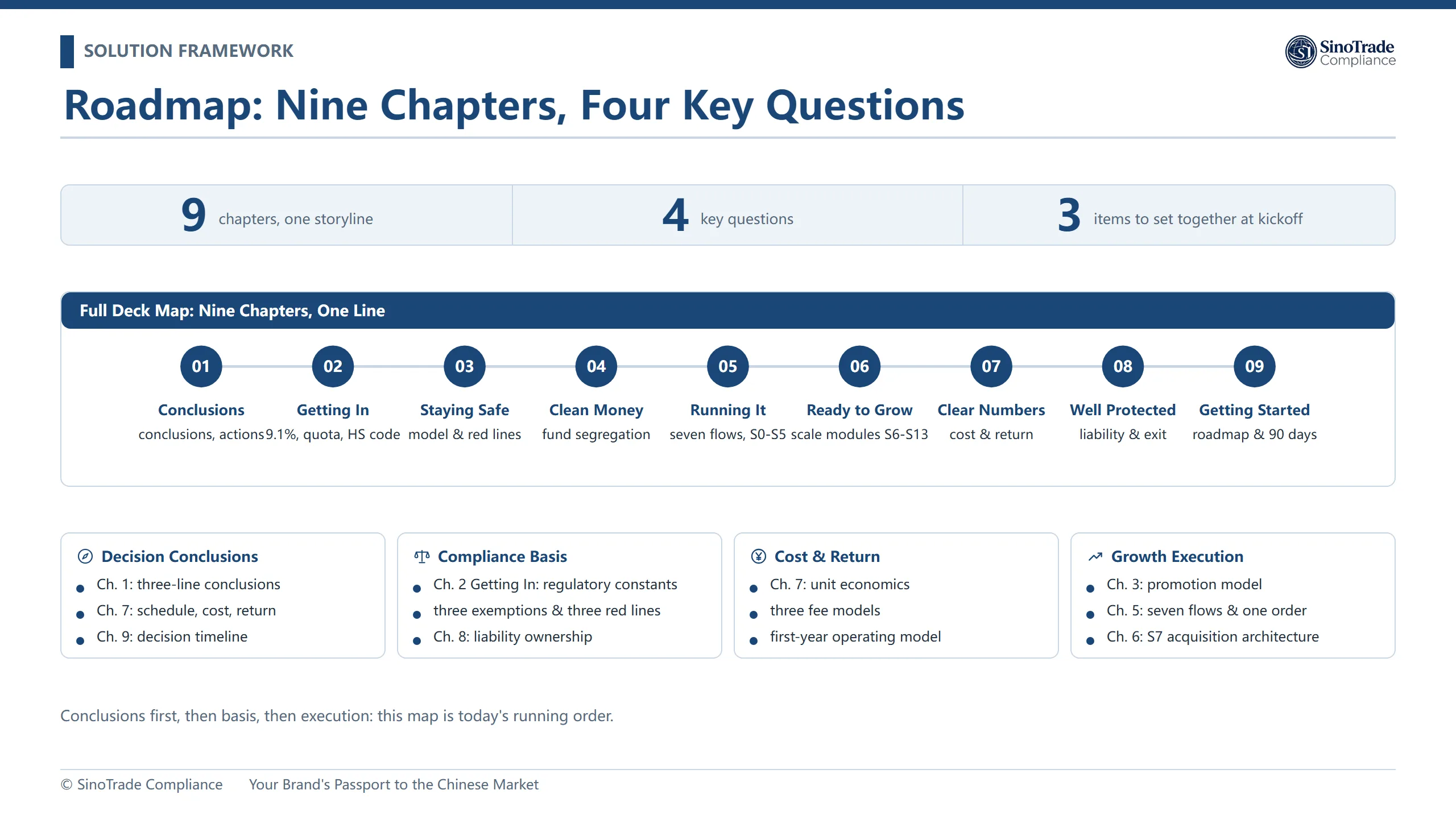
- Quota: 5000 yuan per single order and 26000 yuan per person per year, about 700 and 3600 US dollars, checked order by order by the clearance system.
- Funds: settlement runs in three stages with two levels of separation; there is no per-order remittance abroad.
- Cadence: the diagnostic stage spans two to four weeks and a single-SKU pilot six to ten weeks, on the condition that the diagnosis locks the variables.
The tax math and the two limits
The 9.1 percent consolidated rate is built, not quoted. Customs duty is temporarily set at zero. Value-added tax applies at the statutory rate, 13 percent for milk-derived protein powders, and both VAT and consumption tax are charged at 70 percent of the statutory amount, so 13 percent times 70 percent equals 9.1 percent, under Cai Guan Shui [2016] No. 18. The rate applies only to listed products within the limits; a single indivisible item above the per-order limit is taxed at full goods rates, where the build-up no longer works.
The two limits come from Cai Guan Shui [2018] No. 49: 5000 yuan per single order (about 700 US dollars) and 26000 yuan per person per year (about 3600 US dollars). The ledger is checked order by order at clearance under GACC Announcement No. 194 of 2018, and the buyer can see each deduction in the official mobile channels.
Work the numbers on a concrete jar. A jar priced at 50 US dollars converts at 7.2 yuan per US dollar to about 360 yuan, inside the limits. The consolidated tax is 360 times 9.1 percent, or 32.8 yuan, about 4.5 US dollars, withheld by the platform for the buyer, and the annual ledger of that buyer records a deduction of 360 yuan. The tax is legally the consumer's liability, yet it lands in your retail price, so pricing takes it into account from day one.
The service framework in one picture
The whole program reads as a house. The roof is responsibility: one party answers for the result, from bonded entry to consumer delivery. The beam is the policy base: the mode 1210 route, carried by Cai Guan Shui [2016] No. 18, Announcement No. 486 of 2018 and the 2022 positive list notice. The four pillars are four service lines: access and compliance (S0 diagnosis, S1 entity, S3 filing), platform and fulfillment (S2 store, S4 bonded warehouse, S5 clearance), funds and settlement (S6 settlement, commission, remittance), operations and growth (S7 promotion, S8 after-sales, S13 membership); the fourteen work packages S0 to S13 all live in these four pillars. The foundation is seven flows on one ledger: commercial, goods, logistics, funds, information, compliance and invoicing run on the same set of books, every order leaves traces layer by layer, and when one flow breaks the rest stop.
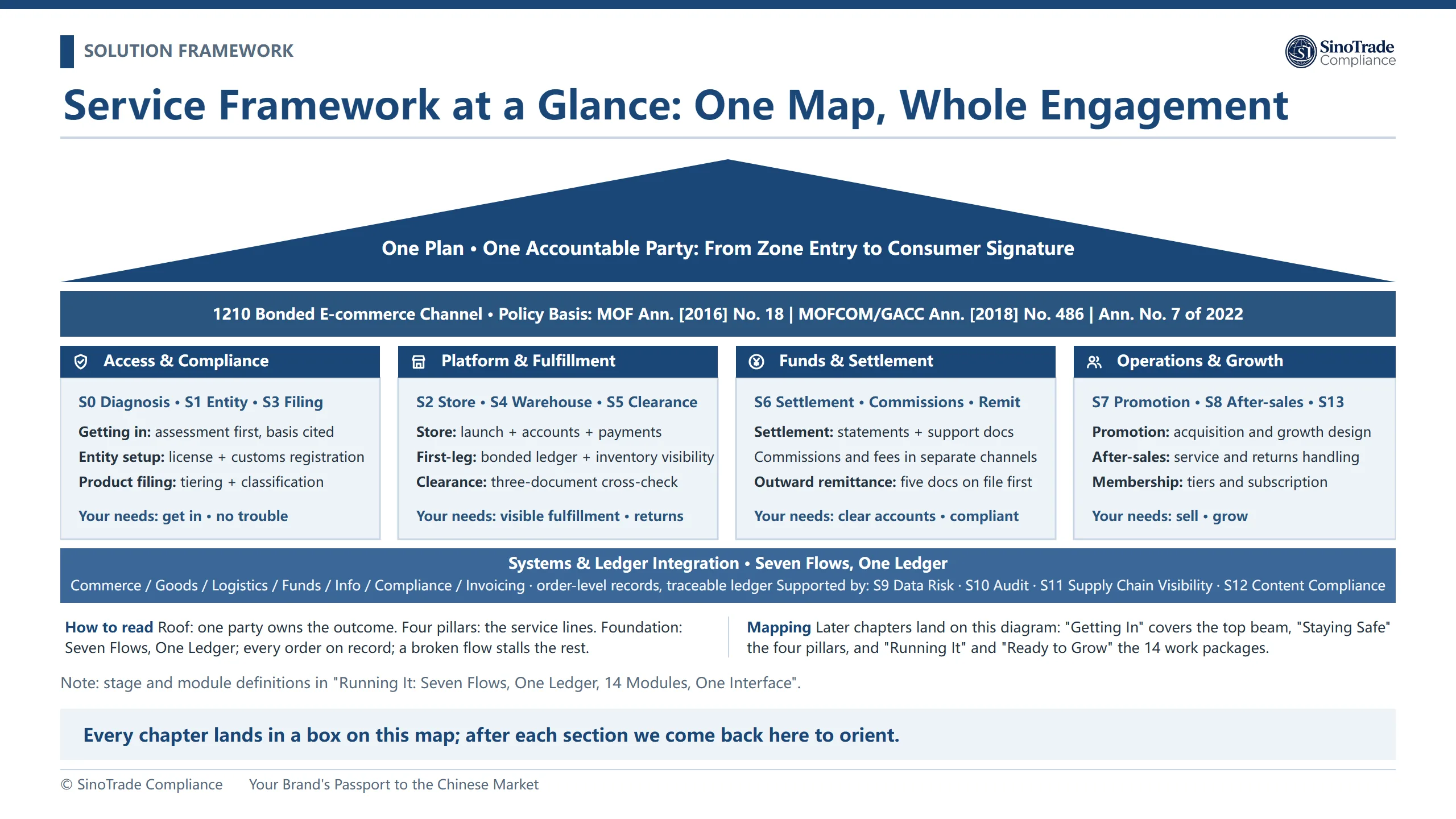
Reading the picture: the roof answers who is responsible, the pillars answer who does what, the foundation answers why it is credible. The order-level ledger makes every link retrievable, and that is the evidence base for every compliance judgment.
Fourteen work packages and what each delivers
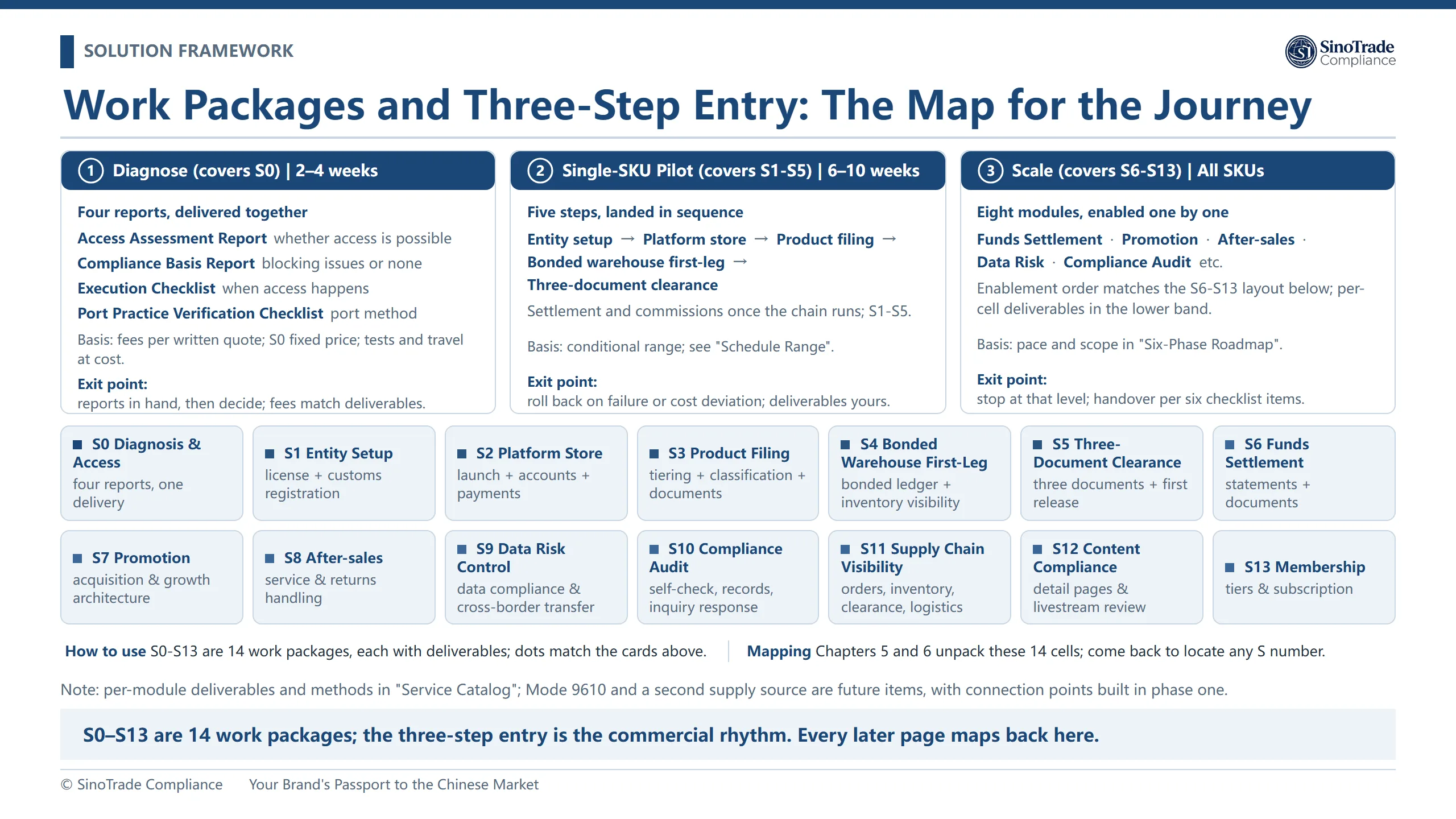
Delivery is packaged into fourteen work packages, S0 through S13, each with defined outputs.
- S0 diagnosis and access: four reports in one delivery, the access assessment, the compliance baseline, the execution checklist and the port-specific verification list.
- S1 entity setup: business licence plus customs registration.
- S2 platform store: launch, accounts and payment rails.
- S3 product filing: tiering, classification and documentation.
- S4 bonded first leg: bonded ledger and inventory visibility.
- S5 three-document clearance: document matching and first release.
- S6 fund settlement: settlement statements with supporting files.
- S7 promotion: acquisition and growth architecture.
- S8 after-sales: service and returns handling.
- S9 data risk control: data compliance and cross-border transfer.
- S10 compliance audit: self-checks, records and inquiry responses.
- S11 supply chain visibility: order, inventory, clearance and logistics tracking.
- S12 content compliance: product page and livestream review.
- S13 membership: tiers and subscription.
The first phase also reserves two extension points, the mode 9610 direct-mail channel and a second source of supply, so that phase two needs no restructuring of phase one.
Three steps in, and how to exit with your assets
The entry is a commercial rhythm in three steps, not a phased delivery. Whatever has been delivered stays yours at every exit.
Step one is diagnosis, covering S0, spanning two to four weeks. The four reports arrive in one delivery, then you decide whether to continue. S0 is billed at a fixed price with testing and travel charged at cost, so the fee maps to deliverables and the decision comes after the reports are in hand. The range is conditional: it holds when diagnosis locks the variables.
Step two is a single-SKU pilot, covering S1 to S5, spanning six to ten weeks. Five links land in sequence: entity, store, filing, bonded first leg and clearance. Settlement and commission switch on only after the chain runs through. The exit: if the pilot fails or costs drift, roll back and keep the deliverables. Starting with one SKU and one port keeps the whole chain honest before scaling.
Step three is scale-up, covering S6 to S13, across the full range. Eight modules switch on one by one: settlement, promotion, after-sales, data risk, audit, visibility, content and membership, in the same order as the packages. Four checks gate the scale-up:
- A first order runs through the whole chain.
- The cost model stays within the tolerance band against measured values.
- The repeat-purchase signal holds.
- The compliance records are complete.
If any check fails, the program stays at pilot level. The exit: stop at any level and hand over against a six-item checklist.
Why move now: the window's value sits in three first-mover assets, the bonded ledger and the port filing slots, the trust of platform categories, and consumer recognition of ingredients. All three take time to accumulate; latecomers do not get the early positions.
One batch of 2000 cans, end to end
Put the route on a concrete batch: 2000 cans of whey protein, retail 50 US dollars per can.
The first leg moves the goods into the special supervision zone in bonded status and opens the bonded ledger; no import duty is paid at this point. The entity already holds the licence and customs registration from S1, and the SKU has cleared tiering and classification under 0404.9000 with ruling W2020-29 as reference. When a consumer orders, the platform pushes the order, the payment and the logistics record; customs matches the three, checks the quota order by order and the platform withholds 9.1 percent, about 4.5 US dollars (32.8 yuan) on a 50 US dollars order, and the ledger records 360 yuan. The parcel leaves the bonded warehouse and reaches the buyer. Returns follow GACC Announcement No. 45 of 2020: the buyer may apply within 30 days of confirming receipt, the goods must reach the bonded warehouse within 45 days, and the quota is restored. The whole chain leaves traces layer by layer on the seven flows and one ledger: which order, which declaration, which payment, which flow, all retrievable.
What this route does not cover
Four boundaries, worth checking before production planning.
- Over-limit orders: a single order above 5000 yuan with an indivisible item, or a buyer above 26000 yuan per year, is stopped by the clearance system.
- B2B volumes: bonded e-commerce retail sells to individuals; distribution, wholesale and corporate purchasing fall outside this route.
- Function claims: health foods must not claim disease prevention or treatment, and the advertising law applies to cross-border goods with full force.
- Port differences: pilot ports differ in operating details; which port of entry and which verification standard apply must be clarified port by port in S0, which is exactly why the port verification list exists as one of the four reports.
This guide describes the rules of the route and how to execute them; it is not legal advice. Before committing a product, run a formal diagnosis for the specific item and the specific port of entry.
Contact us for a formal diagnosis of your product and target port of entry, and the four S0 reports will answer eligibility, port standards and category positioning one by one.