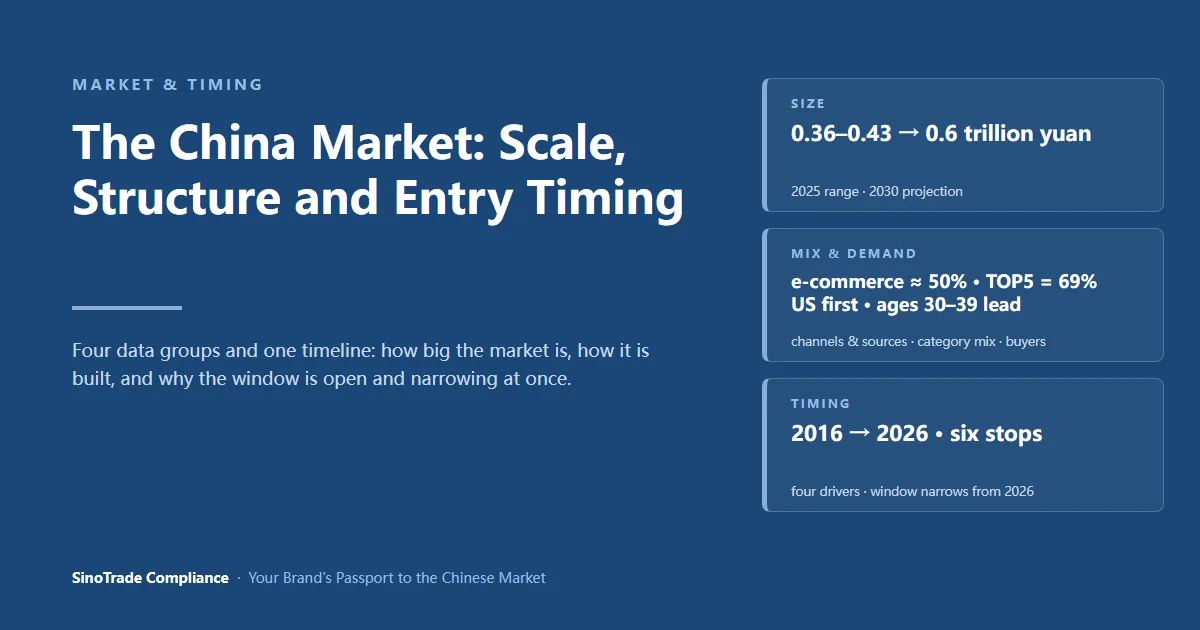
Three questions come before entering China: how big the market is, what its structure is, and why now. The first two are answered with four data groups, the third with one timeline. The conclusion first: the market is there, and the window is opening and narrowing at the same time.
The four groups are market size, channels and sources, category mix, and consumer penetration. Each carries its own basis: third-party estimates for scale, and policies and document numbers you can check line by line.
Start with the two charts. The first is the market, the second is the timing; the data behind both is unpacked in the text.
Size, the ceiling sits on the 0.6 trillion line
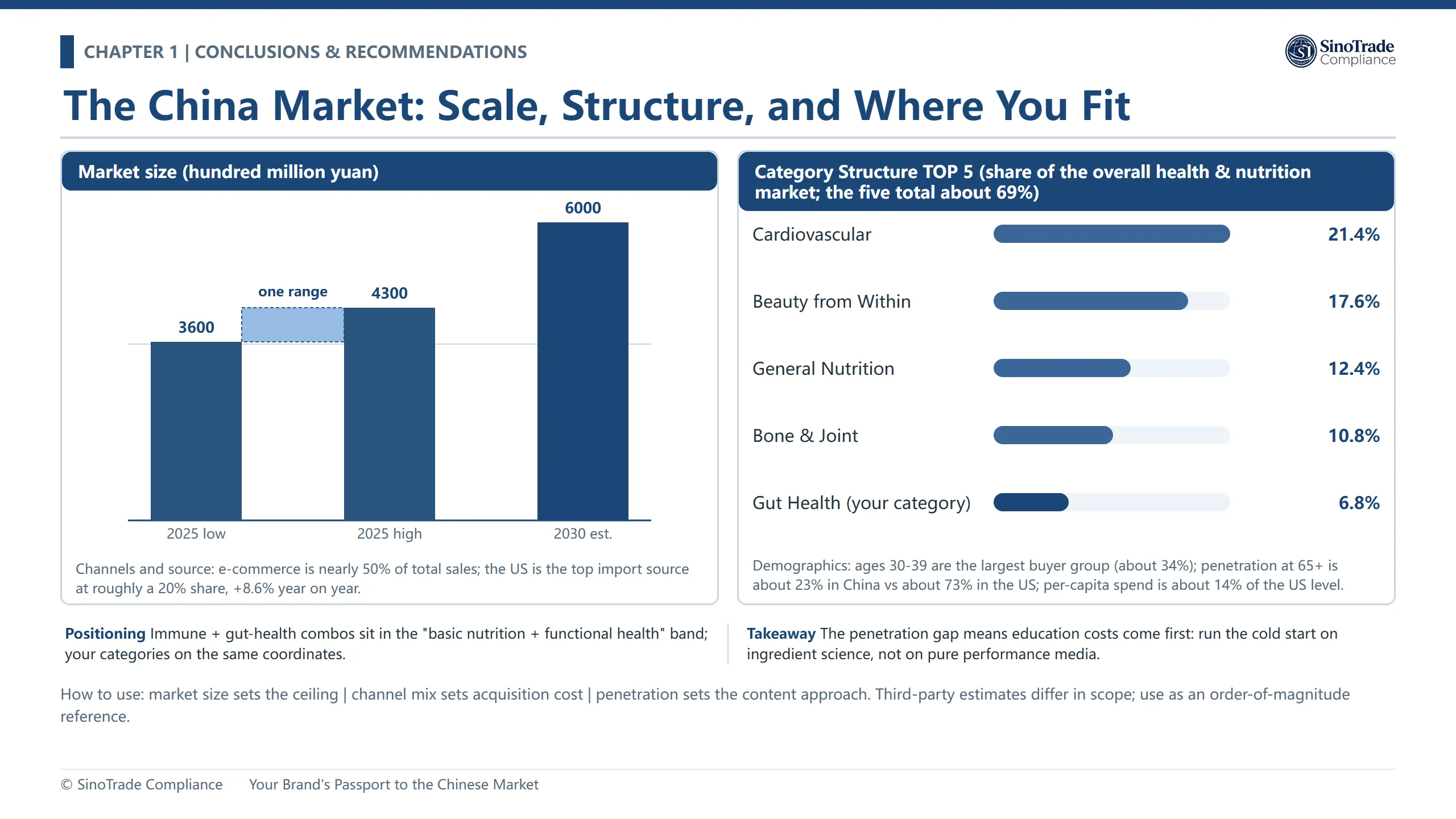
In 2025 the market runs about 0.36–0.43 trillion yuan, and by 2030 it is projected at about 0.6 trillion yuan. The range is not wide, which suggests third-party estimates agree closely on the current size; the 0.6 trillion for 2030 is a direction of growth, not a promise.
The size sets the ceiling. The ceiling sets the upper bound of investment, not the way in; the way in is set by channels, categories and consumers, which the next three groups cover. Third-party estimates differ in method; treat them as order-of-magnitude references and re-estimate for your own category before the number enters a budget.
Channels and sources, e-commerce near half, the US first
E-commerce takes nearly 50% of overall sales. Cross-border and domestic e-commerce together hold nearly half the market, while shelves, food service and other offline channels hold the remaining share; for an overseas brand, e-commerce is the part that reaches consumers directly.
The United States is the top import source: about a 20% share, up 8.6% year on year. Growth continues, but no longer at double digits; a 20% share means imports are spread out, with no single source dominating.
Channels set customer acquisition cost. E-commerce dominance means platform rules, the three documents and qualifications are the entry ticket; spread-out sources mean there is no path dependency on any first-mover country, and product strength plus compliance decide your position.
Category mix, top five hold 69%
By share of the overall health nutrition market, the top five categories are:
- Cardiovascular and cerebrovascular 21.4%
- Oral beauty 17.6%
- General nutrition 12.4%
- Bone and joint 10.8%
- Digestive health (example category placement) 6.8%
Together the five account for about 69%. The top five form the core demand band, and the remaining 31% is shared by long-tail categories; entering the core band means head-on competition with established brands, entering the long tail means building demand yourself. Digestive health sits fifth as a placement example, showing how to use this table to locate a category, not as the only opportunity.
Consumers, ages 30–39 are the largest group
Ages 30–39 are the largest group, about 34%. They are both the main buyers and the main distributors of content, so a cold start begins with them.
Penetration above age 65 is about 23% in China against about 73% in the United States, and per-capita spending is about 14% of the US level. The penetration gap is room, and also cost: the gap means consumer education must come first, so a cold start leans on ingredient education rather than pure performance advertising.
Placement, immunity and gut combinations sit on the core band
Immunity plus gut function combinations land right on the core band of basic nutrition plus functional health; place your category on the same coordinates, item by item.
Three lines close the market section: size sets the ceiling, channels set acquisition cost, penetration sets the content standard. The market is there, but the window has a deadline; the next part looks at it.
Timing, the window is opening and narrowing
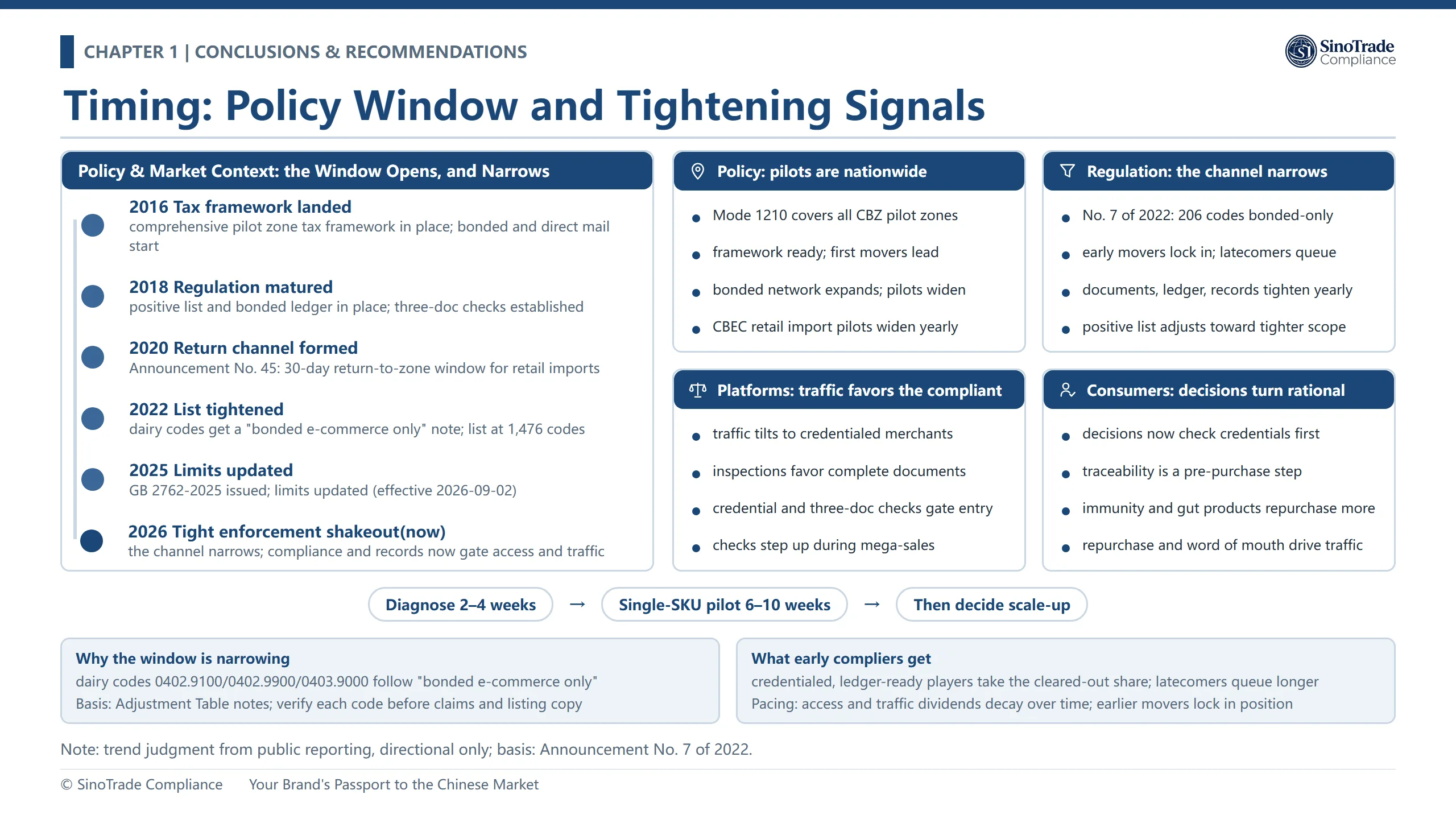
Six stops on the timeline: 2016 tax rules take effect, 2018 supervision matures, 2020 the returns channel takes shape, 2022 the list tightens, 2025 the contaminant limits update, 2026 a strict-enforcement shakeout year (now).
- 2016 tax rules take effect: cross-border pilot zones put the tax rules in place, and bonded online retail and direct mail start as two models.
- 2018 supervision matures: the positive list and the ledger system take shape, the three-document match is established, and the industry scales.
- 2020 the returns channel takes shape: Announcement No. 45 sets the return supervision for cross-border retail imports, with a 30-day window to send returned goods back into the zone.
- 2022 the list tightens: dairy tariff codes gain a bonded-online-retail-only note, and the list grows to 1476 tariff codes.
- 2025 the contaminant limits update: GB 2762-2025 is issued and the ingredient limit rules are updated, effective 2026-09-02.
- 2026 a strict-enforcement shakeout year: the channel narrows, and compliance and traceability become preconditions for access and traffic.
Four drivers point the same way: policy pilots are everywhere, supervision narrows the channel, platforms tilt traffic toward compliant sellers, and consumers return to rational decisions.
- Policy: 1210 pilot coverage now spans all comprehensive bonded zones and cross-border pilot cities; the access framework has taken shape and first movers hold the early position; pilot cities and the bonded warehouse network keep expanding.
- Supervision: Announcement No. 7 of 2022 puts 206 tariff codes under bonded-online-retail-only; documents, ledgers and traceability requirements get finer every year; the positive list is adjusted dynamically and the tightening direction stays clear.
- Platforms: traffic tilts toward sellers with complete qualifications and traceable goods; inspections favour complete documents and checkable chains; qualification checks and three-document capability become onboarding thresholds.
- Consumers: decisions shift from influencer endorsement to checking qualifications and verifying ingredients; checking traceability becomes a pre-purchase step; functional products such as immunity and gut health see higher repeat purchases.
The timing call has to land on a rhythm: a 2–4 week diagnosis, a 6–10 week single-SKU pilot, then a decision on scale. Nobody is asked to do it in one step.
What the narrowing rests on, and what first movers get
The narrowing has a concrete basis: dairy tariff codes such as 0402.9100, 0402.9900 and 0403.9000 in the adjustment table carry the same bonded-online-retail-only restriction. Take the main text and notes of the adjustment table as the standard, and verify code by code before writing claims or listing rules.
What first movers get: those with qualifications, ledgers and platforms in place take over the share freed as players exit; a step later, the threshold is the same but the queue is longer. Access and traffic dividends both shrink with time, so the earlier mover takes an earlier position at the same cost.
A note on basis: trend calls come from public reporting and third-party reports and are directional only; the regulatory basis is Announcement No. 7 of 2022. Market data are third-party estimates, methods differ, so check the latest version before citing.
If you are weighing the market and the timing for health products in China, we can start with a free compliance assessment that puts your category, target channels and consumer placement on one table, then decide where to begin. Contact us with your product and planned launch date.