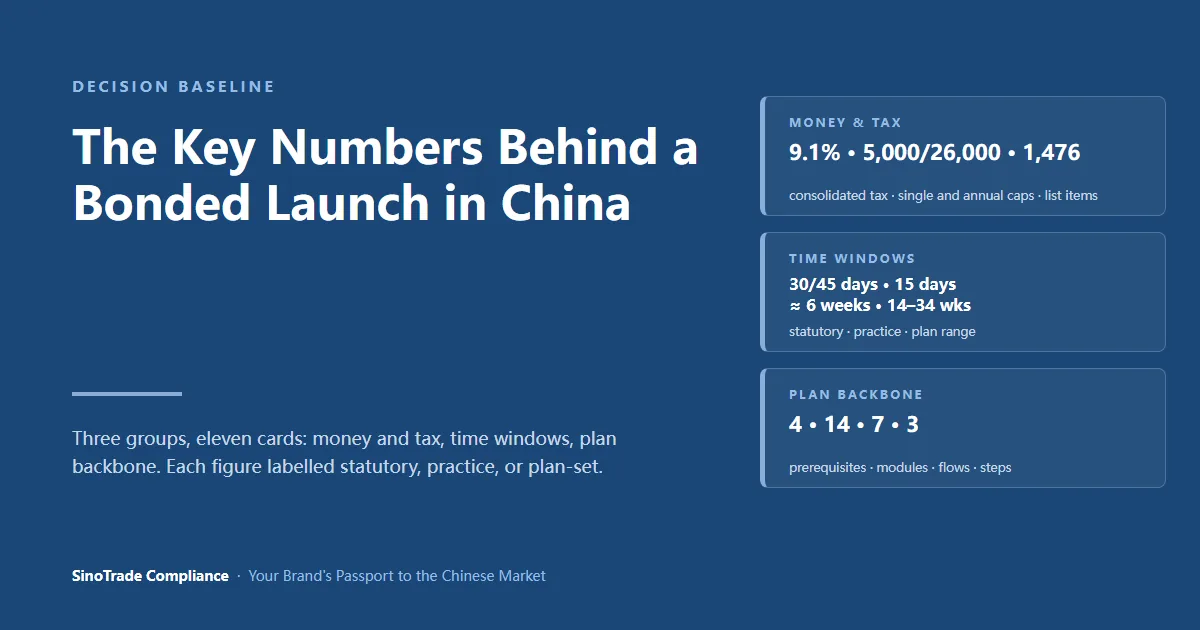
For a bonded launch in China, line up three groups of numbers first: three money and tax items, four time windows, four plan numbers. The first group comes with document numbers you can check; in the second, only one item is a statutory deadline, while the rest are practice and a range set by this plan; the third is our own working set for scheduling. Eleven cards in three groups, one baseline for quotes, schedules and scope; only then does the rest of the conversation hold together.
The numbers are easy to remember; the hard part is knowing how far each one reaches. 9.1% comes with conditions, 30/45 days comes with a start date, 15 days and about 6 weeks are only practice, and 14–34 weeks holds only if the preconditions hold. Keep those layers apart, and you know which number can go into a budget and which belongs only in your internal schedule.
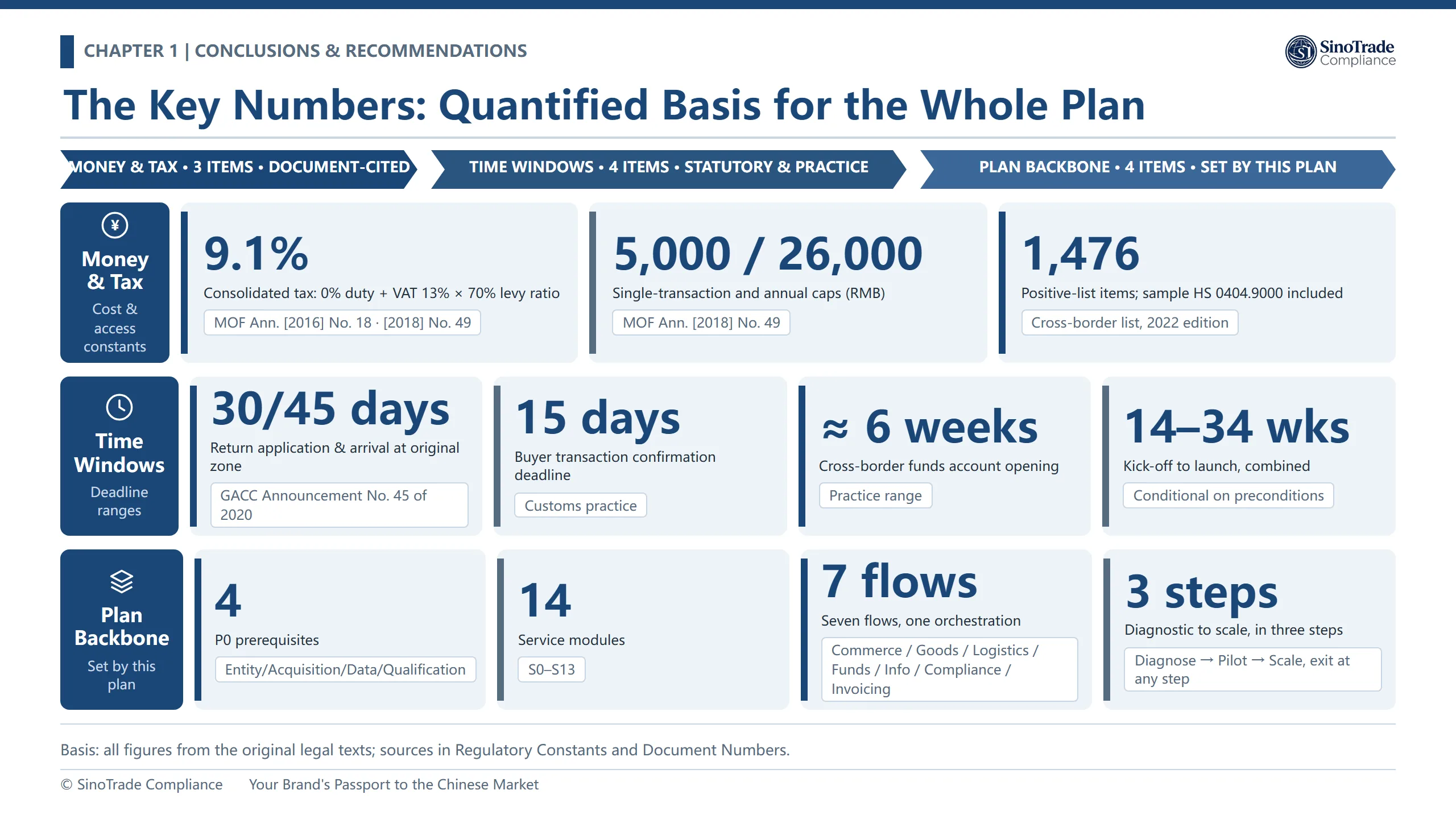
The eleven cards sit on one page, one row per group. Start with their positions on the figure, then go through the numbers group by group.
Money and tax, all three carry document numbers
Three cards in this group, marked document-cited on the page. Every number comes with a document number you can check line by line; the three cards govern cost, the volume per order and per year, and the scope of the list.
- 9.1%: the consolidated tax has two parts. The tariff rate is temporarily set at 0, and VAT is levied at 70% of the statutory amount: 13% × 70% = 9.1%. The basis is Cai Guan Shui [2016] No. 18 and Cai Guan Shui [2018] No. 49. This rate applies only to goods on the positive list and orders within the single-order cap; if the goods carry consumption tax, that tax is also counted at 70%, and 9.1% is no longer the whole cost.
- 5000 and 26000: 5000 yuan per order, about 700 US dollars; 26000 yuan per person per year, about 3600 US dollars, under Cai Guan Shui [2018] No. 49. The quota accumulates per buyer and is deducted order by order at clearance. Orders above the single-order cap, orders that push the annual total past 26000 yuan, and a single indivisible item with a dutiable value above 5000 yuan are all taxed in full as general trade; the consolidated rate and the quota deduction no longer apply.
- 1476: the positive list under Announcement No. 7 of 2022 contains 1476 eight-digit tariff codes, and the sample code 0404.9000 is on it. The number shows the size of the list; it does not decide your category. Check the list notes and supervision conditions for each code. Dairy categories, for example, carry limits such as bonded online retail only.
All three are statutory; what differs is what they govern. 9.1% governs the VAT layer of cost; 5000 and 26000 govern how much fits in one order and how much one buyer can buy in a year; 1476 governs which categories are allowed in. Look at the first two before quoting, and at the third before choosing products.
Taken together, they map to three access conditions: the category is on the positive list, the buyer is an individual for personal use, and the order is within the caps. If one of the three fails, the cost calculation does not apply. The line at the foot of the page, "every number comes from the original legal text", is what this group rests on: a number without a source does not enter this table.
Time windows, four numbers with four different kinds of force
Four cards in this group, marked statutory and practice on the page. Only the first is written in a regulation; the other three are practice or a range set by this plan. Put the four on one page, and they are easily misread as a single "how long".
- 30/45 days: a return must be applied for at customs within 30 days of the release date of the declaration list, and the returned goods must reach the original customs supervision site, the original special customs supervision area or the Bonded Logistics Center (Type B) within 45 days of the same release date, under GACC Announcement No. 45 of 2020. If the conditions are met, the tax is not levied and the consumer's annual cumulative transaction amount is adjusted accordingly. Both clocks start at release: 30 days for the application, 45 days for arrival; the 45 days do not restart from the application date.
- 15 days: the time limit for buyer transaction confirmation, as customs practice. It governs the order confirmation step and does not change the starting point of the return window; the page marks it customs practice to remind you not to use it as a legal provision.
- About 6 weeks: opening a cross-border funds account, a practice range. Due diligence and account opening schedules differ by bank and by port; this number belongs in an internal schedule, not in an external commitment.
- 14–34 weeks: the combined range from kick-off to launch, conditional on the preconditions, with 2–4 weeks for diagnosis and 6–10 weeks for a single-SKU pilot, and the remaining stages scheduled by module. The page marks it conditional on preconditions; if the preconditions do not hold, the range does not hold either.
Of the four, only 30/45 days is written in a regulation; 15 days and about 6 weeks are practice, and 14–34 weeks is a range this plan adds up stage by stage. Once they are separated, a schedule can say "usually" without reading as a commitment.
Plan backbone, four numbers that define scope
Four cards in this group, marked set by this plan. They are not regulatory requirements; they are the four measures we use to break a project apart. Change providers, and the numbers may differ, but scope, responsibility and exit points must still line up.
- 4 P0 prerequisites: entity, acquisition, data and qualification. P0 means the preparation stage before project kick-off; all four are settled here, and if any one is unsettled, the project stops rather than moves on.
- 14 service modules: S0–S13, from diagnosis and access all the way to membership operations, covering access, store opening, clearance, funds, promotion, after-sales, data, content and membership across the chain.
- 7 flows: commerce, goods, logistics, funds, information, compliance and invoicing, all sharing one set of books and one order number.
- 3 steps: diagnose, pilot, scale. Every step has an exit point; you can stop at any step.
What the four prerequisites mean: the entity is a wholly foreign-owned enterprise, a joint venture, or, during a transition period, the platform acting as the domestic entity; choose one of the three. Acquisition turns promotion income into service fees, designed under the four prohibitions and two limits: no stockpiling, no resale, no entry fees, and no more than two team levels; pay is based on attributed transaction value, contracted onshore with individual income tax withheld. Data is kept within the exemption tier for outbound transfer; an annual volume below 100,000 people does not trigger a filing. Qualification is regulated as articles for personal use, does not constitute direct selling under the Direct Selling Regulations, and needs no direct-selling license, per Announcement No. 486 of 2018 of six departments and State Council Decree No. 443, the Direct Selling Regulations.
The fourteen work packages start with S0 diagnosis and access and end with S13 membership operations: S1 entity setup, S2 platform store, S3 product filing, S4 bonded warehouse first leg, S5 three-document clearance, S6 funds settlement, S7 promotion and distribution, S8 customer service and after-sales, S9 data risk control, S10 compliance audit, S11 supply chain visibility, S12 content compliance. Each has a deliverable and an acceptance standard; scheduling follows module activation, not department boundaries.
The seven flows are seven faces of one set of books: commerce records orders and contracts, goods records batches and shelf life, logistics records tracking and delivery, funds records receipts, payments and balances, information records interfaces and order status, compliance records declarations, filings and checkpoints, and invoicing records invoices and credit notes. All seven share one set of books and one order number; if one flow breaks, the other six can be reconciled, and that is how the problem is located.
The three steps are diagnose, pilot and scale. Diagnosis takes 2–4 weeks and produces four reports, putting access, basis, sequence and port practice on paper; the pilot runs one SKU over 6–10 weeks, validating the three-document match of order, payment and logistics and the first-order cycle; scale-up activates modules one by one, with a second supply source and extension interfaces reserved in the first phase. Every step has an exit point: you can stop after diagnosis, after the pilot, or during scale-up at the current module. Exit is a normal option; controlling risk at the current stage is cheaper than moving on with unverified preconditions.
Turning eleven cards into one set of numbers
Take a whey protein powder priced at 60 US dollars. At 7.2 yuan per US dollar, one can costs 432 yuan, within the 5000 yuan single-order cap, so one order can hold at most 11 cans. The consolidated tax per can is 432 × 9.1% ≈ 39.3 yuan, about 5.5 US dollars, withheld and remitted by the platform. The same buyer has a 26000 yuan annual quota, which at this price buys about 60 cans.
A first order of 300 cans. The retail value of 300 cans is 18000 US dollars, or 129600 yuan, and the consolidated tax, estimated on the retail price, is about 1638 US dollars. Those 300 cans will not become one order: the single-order cap is 5000 yuan, so they must be split across many buyers' orders; if every buyer used their full annual quota on this one product, it would take at least 5 buyers' annual quotas. In practice, buyers also spend quota elsewhere on cross-border goods, so the real number of buyers can only be higher.
On the time side, prepare 14–34 weeks from kick-off to launch for the first order; opening a cross-border funds account takes about 6 weeks and runs in parallel during diagnosis, not as a separate stage. The return window starts at the release of the declaration list: apply within 30 days and deliver the goods back to the original area within 45 days; past that window, neither the tax nor the quota is restored.
Break the calculation apart: price decides how many cans fit in one order, quota decides how many buyers you need, the time window decides when the first order can start selling, and the plan backbone decides who does what at which stage. When the four layers line up, the quote, the schedule and the scope come from the same set of numbers.
What these numbers do not cover
These eleven cards are a baseline, not a pass. Here are five things they do not answer:
- Access decisions for a specific category. 1476 is the size of the list, not a conclusion about your SKU; tariff classification, list notes and supervision conditions must be checked item by item.
- Goods subject to consumption tax. 9.1% combines only the tariff and VAT; when consumption tax applies, another layer is added, and you cannot apply 9.1% directly.
- Local and institutional differences. 15 days and about 6 weeks are practice; ports, banks and platforms differ, so check the local practice again before signing.
- Commercial terms. Pricing, channels, commission rates, budgets and return on investment: these numbers give boundaries, not a quote.
- Policy versions. The positive list, caps, data thresholds and return rules are updated; check the current version before citing, and do not plan a new year on last year's numbers.
These numbers answer the question of cost, schedule and scope. They do not replace tax or legal advice, nor the item-by-item access check for a category.
Why move now
Lining up the three groups takes little time, but it decides whether every later quote, schedule and scope change uses the same ruler. A baseline set early saves the project from walking back.
Entering late also has a cost. The positive list changes by version, caps move by year, and port and warehouse slots are scheduled in practice; for the same project, the later you move, the fewer ports you can choose and the fewer windows you can book. Brands that enter early lock in more than warehouse space: they lock in the trust position for their category on the platform and their core customers' awareness of the ingredients.
Wait when waiting is called for. If one of the four P0 prerequisites is unsettled, or one of the three access conditions fails, settle access first and do not start the pilot. Numbers are a ruler; measure before you move, and it is cheaper than rushing in without measuring at all.
If you are preparing a bonded project in China, we can start with a free compliance assessment: put the category, tariff code, target channels and these eleven cards into one table, then decide which step to start from. Contact us and tell us the product and your planned launch date.