Selling supplements, food and cosmetics into China through bonded warehousing is a workable route, under three conditions: the category is on the positive list, the buyer is an individual purchasing for personal use, and the order value stays within the limits. When all three hold, one very unglamorous question remains: from bonded entry to consumer delivery, is there a single party willing to own the whole thing. Four suppliers each cover a segment, each answers only for its own segment, and when something breaks nobody can give a complete answer. However detailed the contracts, after an incident the indemnity clauses never land on a party that can truly stand behind the whole chain.
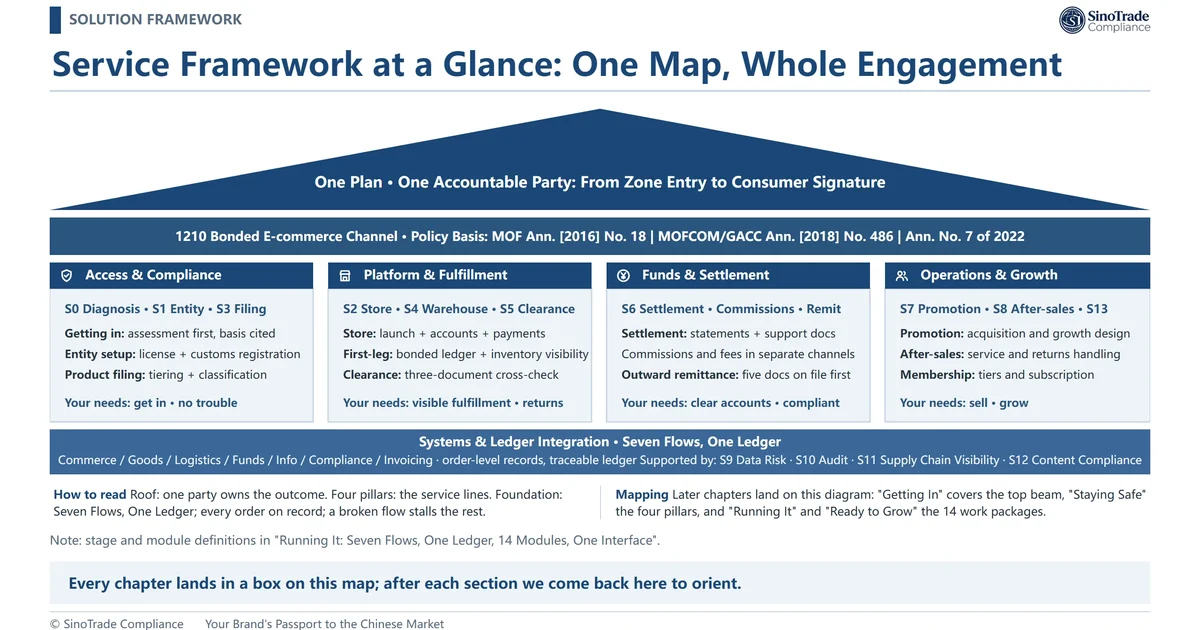
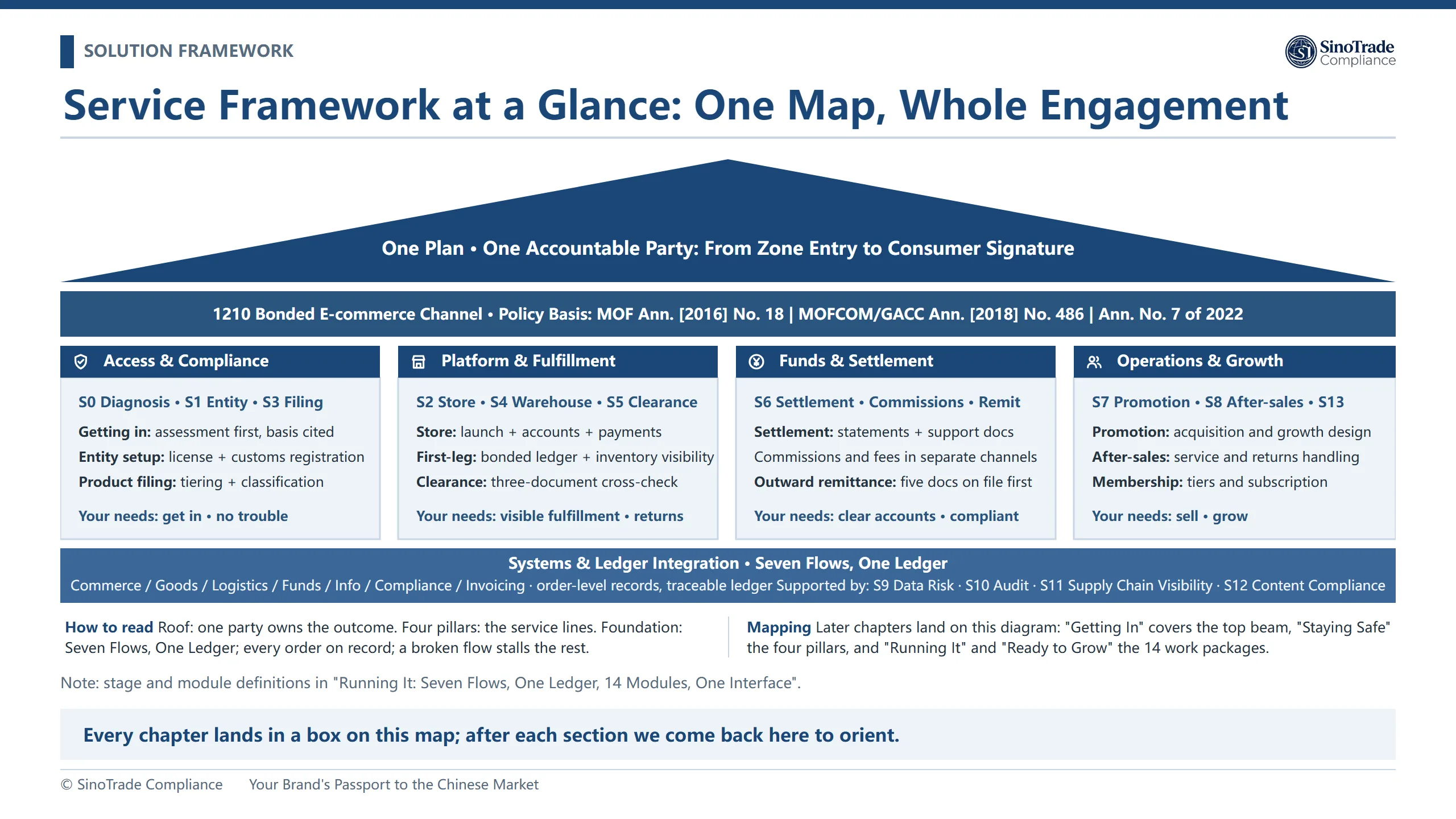
This is the framework diagram we use on bonded projects. The roof is accountability, the beam is the legal basis, the four columns are the four service lines, and the foundation is seven flows on one ledger. Which load bearing parts a project consists of, where a broken part cracks first, and who to call when it needs fixing, the diagram marks all of it. Tax and quotas are a separate ledger, not in this diagram.
Accountability first, because everything else reports to it
Goods inside the bonded zone have not cleared import tax formalities yet, and consumer orders are declared one by one. This structure forces responsibility to be a single line, not segments. The brand signs one agreement with one party; that party answers for the whole chain of bonded entry, warehousing, clearance, delivery and after sales, and when something breaks you go to it, while it traces back internally through the work packages.
Open up the division of labor among suppliers and the three most accident prone divisions I have seen are:
- The customs broker answers only for declaration data; two months of storage fees from goods sitting in the bonded warehouse are not its problem;
- The warehouse operator answers only for stock counts; slow picking, wrong or missed shipments get blamed on system interfaces;
- The ecommerce agency answers only for sales; a listing taken down for claim violations was, it says, caused by the brand's own materials.
Each statement sounds reasonable on its own; put together, they leave no answer. The consumer waits for goods that never arrive, the platform docks the store's score, customs summons the domestic entity, and the pressure all lands on the brand, which holds nothing but four contracts in which nobody is liable.
The beam has three documents, copy the numbers down
The roof rests on the beam. The customs supervision code of this channel is 1210, officially bonded cross border trade e-commerce, known in practice simply as bonded e-commerce. Three documents form the beam, each governing one boundary, and when you build a plan you should at least know their numbers by heart.
Cai Guan Shui [2016] No. 18, issued by the Ministry of Finance, the General Administration of Customs and the State Taxation Administration, sets taxation: the per order and annual transaction limits, and how customs duty and import stage taxes are collected. For anything about money, this is the document.
Announcement No. 486 of 2018, issued by six departments led by the Ministry of Commerce, sets supervision: which goods may enter as articles for personal use, what documents release them, and how returns are handled. For whether your goods can enter, this is the document.
The same announcement fixes the technical standard for release: the order, the payment and the logistics record must match, and parcels are released only after the system comparison passes; returns follow the path defined by GACC Announcement No. 45 of 2020.
Announcement No. 7 of 2022, issued by eight departments led by the Ministry of Finance, revised the list of goods eligible for cross border e-commerce retail import, known in the trade as the positive list. Whether your category is inside the door, and whether you are limited to direct purchase or may also use bonded warehousing, the answer is in this document.
The height of the beam is the height the house can reach. If your category is not on the list, no framework diagram, however complete, will raise the building. So the first step of any cooperation is checking the list and the tariff codes, getting the product through the door before anything else. Only when this step is done do the columns take their turn.
Four columns, each covering a segment, but transmitting load to each other
Fourteen work packages, S0 through S13, hang on the four columns.
The access column carries S0, S1 and S3. Diagnosis first: lay out the product, the tariff codes and the target channels, and decide whether the route works at all; if this stage does not land, every later quotation is built on air. Then the entity: a business licence and customs registration, and the system opens no account with either one missing. Last come filing and classification. Get the tariff code wrong and every later declaration needs an amendment. Classification is the most underestimated step: within protein products, whey protein powder goes under 0404.9000, while a fortified solid drink mixed with other ingredients may fall under 2106; when the code moves, list eligibility and tax rate move with it.
The second column starts with the store launch, but the real pressure comes on clearance night. The order, the payment record and the logistics record have to match order by order; one mismatched timestamp and the parcel just sits there. The bonded warehouse ledger also has to be visible to the brand; if you cannot see inventory, preselling is a bet on stock you have not verified.
The hidden workload of the store segment is qualifications: the business scope on the licence, the food operation permit, and the platform deposit; only when all three are in place does the category open.
The third column handles money, and its most common failure is commissions and goods payments travelling through the same pocket. Once the two streams mix, reconciliation cannot tell which transfer pays for goods and which is a service fee, and when the bank asks for documents on remittance you are left scrambling. Five files should be ready before remittance: the contract, the invoice, the customs declaration or verification voucher, a logistics or order voucher, and bank supplementary material; miss one and you make the trip again.
The fourth column is operations: S7 promotion, S8 after sales, S13 membership. It is the easiest to treat as icing, but when the returns process is not built, membership data is dirty and every repeat purchase rate is a fake number. The S8 return rate is the thermometer of operations; if return reasons are not classified finely, S7 keeps adding budget to the wrong audience.
Columns transmit load to each other; the diagram cannot draw this, but projects live it daily. When S5's three documents fail to match, S6 cannot issue a settlement statement; when S3's tariff code is wrong, S5 amends declarations, and the amendments drag S2's inventory turnover; when S8's returns process is missing, S13's membership tiers have no trustworthy data. One column fails, the neighbors take the load first, and in the end it reaches the roof, where the responsible party catches it.
The foundation is seven flows on one ledger, and a break shows in the ledger first
The seven flows are not seven systems; they are seven kinds of records. Commerce records orders and contracts, goods records batches and shelf life, logistics records tracking and delivery, funds records payments and balances, information records interfaces and order status, compliance records declarations, filings and checkpoints, invoicing records invoices and credit notes. One ledger means all seven records share a single order number, and whichever flow breaks can be traced back from that number. In the diagram the seven flows run into the same ledger; the broken one simply leaves a missing line.
Beneath the foundation sit four supporting modules: S9 data risk, S10 audit, S11 supply chain visibility and S12 content compliance. They earn no revenue directly, but they decide whether this ledger can defend itself when something goes wrong.
Among the seven flows, the first to break is usually not goods but information and invoicing. Goods lying in a warehouse do not disappear, yet when order status sync lags half a beat, support cannot answer the consumer's questions; when the invoice cannot be issued, reconciliation never balances, and the consumer who wants proof gets nothing.
A true story. A batch of 1200 bottles of fish oil, a consumer applies to return on the seventh day after signing for delivery, saying the date on the label is unreadable. With records on all seven flows this takes half an hour: compliance pulls the Chinese electronic label version used at listing, goods checks the batch and shelf life, logistics confirms the delivery time, funds verifies the refund, invoicing issues the credit note, S8 arranges the reshipment, and every action hangs on the same order number.
I have also seen the version without the ledger. The warehouse says the delivery record is with the courier, the courier says the waybill details belong to the platform, the platform says refunds need the merchant's consent first, the merchant says the label was printed by the factory. One round of calls, the seven day window is gone, the consumer complains to the platform, the store's score is docked, and the slot in the next big promotion disappears. Same incident; the difference is not capability, it is whether that ledger exists.
Why the fourteen packages are cut this way
The fourteen work packages are not cut along systems but along signing authority. Each package corresponds to one deliverable that can be accepted and pursued separately: a diagnosis report with a signature, a licence with a signature, a filing receipt with a signature, a settlement statement also with a signature. The person who signs is accountable for that package.
Cut this way, quotations and acceptance both land on packages. You pay for fourteen deliverables, not for something vague called a service; whichever deliverable is missing, its package is not accepted. Fault isolation gains coordinates too: when something breaks, first name the package, then discuss whose people are involved.
Packages have an order among themselves: until S0 is concluded, S1 and S3 cannot start; until S3's tariff code is settled, S4's warehouse entry forecast is wrong; only after S5 runs one shipment cleanly can S6 talk about reconciliation. Get the order wrong and rework costs far more than the time saved.
Two reservations belong in the plan from the design stage. One is the interface to the 9610 direct purchase channel: when a category can only go direct purchase, or the bonded warehouse temporarily lacks capacity, orders exit through that channel while the ledger stays the same. The other is a second source: one SKU qualified with two overseas shipping entities, so if one has a qualification or logistics problem, the other steps in.
What this diagram does not cover
The framework governs structure, not choices. Four questions it does not answer:
- Which registration path the product takes, how to trade off blue hat registration, bonded warehousing and ordinary trade, depends on category, ingredients and budget;
- Pricing and channels, which platform to pick, how to set the price band, how to schedule promotions;
- The equity and tax structure of the domestic entity;
- Access judgment for a specific category, where every tariff code needs its own check against the list and the supervision conditions.
Push these four into the framework discussion and the conversation loses focus. Stand the framework up first, then fill the four in item by item.
Three questions that filter out unreliable plans
Last year a client brought three quotations and asked which was cheapest. The three scopes of service were not comparable at all: one covered clearance only, one covered warehousing and delivery but not filing, and one looked all inclusive until you noticed settlement required a separate agreement. The prices could not be compared directly.
For any bonded plan, three questions are enough:
- Who is responsible: does the contract point to one party, and does its scope run from bonded entry to delivery;
- Where it breaks: which of the seven flows lacks order level records, which column lacks acceptance criteria;
- Who repairs: when a fault happens, who has the authority to amend declarations, adjust stock and start refunds, and how quickly it can be closed.
If all three questions have clear answers, the framework is real. If one cannot be answered, the plan is still on paper.
Internally we call this the house diagram. When we present a plan we draw it first, and eight times out of ten the first reaction is the question of how many people their own team must commit. The answer varies by project, but at the S0 stage you need at least one decision maker present throughout.
The barrier to bonded cross border e-commerce is not policy; policy is public and the document numbers are written above. The barrier is structure: whether one party is willing to own the whole line, whether one ledger strings the seven flows together, and whether a work package list maps every dollar of spend to a deliverable. With those three in place the project can start. If your product line spans several categories and you are comparing providers, we can first run a free compliance assessment, laying out categories, tariff codes and target channels into one access list, then judge which path deserves investment. Contact us with your product and planned launch date.