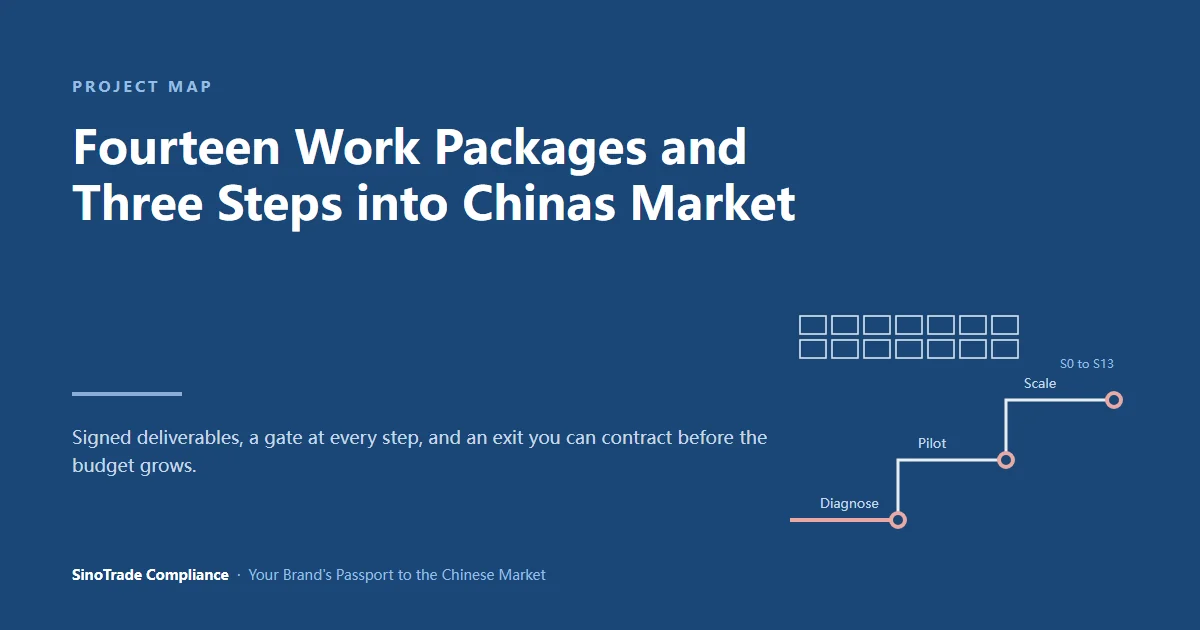
Whether a bonded project is feasible starts with a diagnostic that runs about two to four weeks; four reports land in your hands before you decide whether to continue. If you continue, one SKU goes through a pilot of about six to ten weeks, and scale begins only after the first order clears. Every step can stop, and whatever has been delivered belongs to the brand. Those three sentences are the whole entry route. The remaining question is how to cut it into who signs, who delivers, and when acceptance happens.
Fourteen work packages, S0 to S13, run from diagnostic, entity, store and filing through first leg and clearance, then settlement, promotion, after-sales, data, audit, supply chain visibility, content compliance and membership. The three-step entry is a commercial rhythm, not staged delivery: the diagnostic covers S0, the pilot covers S1 to S5, and scale covers S6 to S13. A package is a delivery unit; a step is a decision gate. Do not confuse the two.
The three steps and the fourteen packages, on one map
The map has three steps, and three numbers to remember: 3 entry steps, 3 exit points, 4 S0 deliverables.
The first step is the diagnostic, covering S0, about two to four weeks, producing four reports. The second is a single-SKU pilot, covering S1 to S5, about six to ten weeks, with five links landed in sequence. The third is scale, covering S6 to S13 and all SKUs, with eight modules enabled one by one. An open breakpoint sits at the right end of each step: at the end of that step you may exit, and the documents already delivered belong to the brand.
The lower half consists of three step cards; what has to be done at each step is collected on one card: the diagnostic card lists the four reports and the decision after the diagnostic, the pilot card the chain running, the pre-scale checks and the rollback conditions, the scale card the rollout of all SKUs and exit per contract stages. Work packages are not cut along systems; they are cut along deliverables that can be accepted on their own.
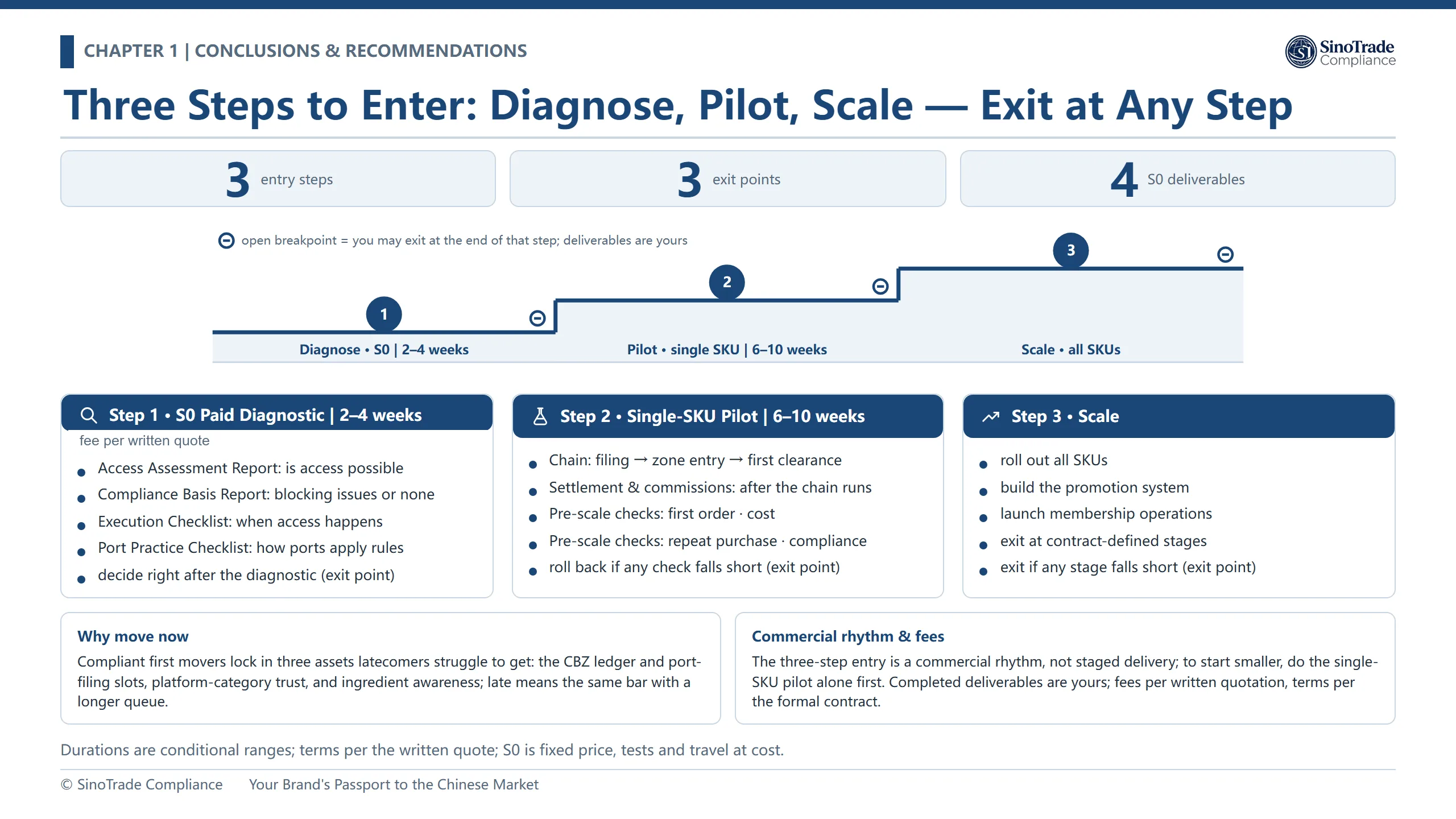
The durations on the map are conditional ranges, explained later; S0 is fixed price, tests and travel at cost. When an S number appears later, come back to this map to locate it.
The first step buys a clear answer in two to four weeks
The diagnostic does one thing: it settles whether access is possible and how it happens. Four reports arrive together:
- Access Assessment Report: answers whether access is possible, with the tariff code, list and supervisory conditions;
- Compliance Basis Report: answers whether any blocking issue exists, with a document number behind every conclusion;
- Execution Checklist: answers when access happens, with the sequence and the materials required;
- Port Practice Verification Checklist: answers how the port applies the rules, for the same tariff code at the target port.
The diagnostic is a fixed-price service, fees per written quote, tests and travel at cost. When the reports are in hand, decide whether to continue or stop; fees paid match deliverables, and there is no bill for a stage that never starts.
Often the diagnostic buys a no. A solid-drink brand had two ingredients that left both classification and positive list eligibility uncertain. The report laid out the tariff code, the list and the port practice, the brand reformulated, and only then entered the pilot. The diagnostic fee was small change; what it saved was rework across the whole chain.
Nor are the four reports four slide decks. The access report must point to a specific tariff code, the compliance report to a specific document number, the execution checklist to specific materials, and the port checklist to a specific port. If any one stays at the level of principle, the pilot will replay the problem.
The second step runs one order through a six to ten week pilot
The pilot does one SKU only, in five links that cannot change order:
- Entity setup: business licence and customs registration; with either missing, the system opens no account;
- Platform store: store launch, collection account and payment channel;
- Product filing: tiering, classification and documents; a wrong tariff code means every later declaration is amended;
- Bonded warehouse first leg: goods enter the bonded warehouse, the bonded ledger opens, and inventory is visible to the brand;
- Three-document clearance: order, payment and logistics records match, and the first shipment is released.
Only after the chain runs and is confirmed do settlement and profit sharing come up.
The pilot has four observations that decide whether scale can start: whether the first order runs, how large the cost deviation is, whether repeat-purchase signals appear, and whether any compliance issue exists. If one of the four falls short, roll back. A rollback is not a failure; it keeps the scale budget in your pocket, and delivered items still belong to the brand.
A batch of 1,800 boxes of vitamin C effervescent tablets cleared the first order of 240 boxes out of the zone. At the second-week review, fulfillment cost per order was 22 percent above the quote, caused by picking whole cases down to single boxes. The team changed the pack to six boxes per case, cost returned to the agreed band, and only then did scale begin. That round added no budget; it added two weeks and one packaging change.
If the first order does not run, check whether the three documents match, whether the filing covers that SKU, and whether the cost basis includes repacking and returns. Then decide whether to roll back or rerun. Do not scale with the problem still open.
The third step enables eight modules in dependency order
Scale covers S6 to S13, with eight modules enabled one by one; the order is the dependency order:
- Funds settlement: statements and documents, opened first once the pilot runs;
- Promotion and distribution: acquisition and growth architecture, with stable fulfillment before paid reach;
- Customer service and after-sales: service and returns handling; without a returns process, membership data is dirty;
- Data risk control: data compliance and cross-border transfer; draw the line on what may leave first;
- Compliance audit: self-check, records and inquiry response; keep records in normal times so answers exist under inquiry;
- Supply chain visibility: orders, inventory, clearance and logistics in one view;
- Content compliance: detail pages and livestream review, before material goes live;
- Membership operations: tiers and subscription, only after repeat purchase stabilizes.
Scale does not mean rolling out every SKU at once. It opens in stages defined by the contract; each stage has acceptance items, and a stage that falls short stops there. The cost of stopping is usually lower than the cost of scaling with the problem.
The pace and first-phase scope are set in the six-phase roadmap; per-module deliverables and methods are in the service catalog, not on this map.
The fourteen packages are cut by signing authority
The fourteen work packages are not cut along systems; they are cut along signing authority. Each package matches one deliverable that can be accepted and pursued separately: a diagnostic report with a signature, a licence with a signature, a filing receipt with a signature, a settlement statement with a signature. The person who signs is the responsible party for that package.
| Code | Work package | Deliverable |
|---|---|---|
| S0 | Diagnosis and access | Four reports delivered together |
| S1 | Entity setup | Business licence and customs registration |
| S2 | Platform store | Store launch, accounts and payments |
| S3 | Product filing | Tiering, classification and documents |
| S4 | Bonded warehouse first leg | Bonded ledger and inventory visibility |
| S5 | Three-document clearance | Order, payment and logistics records, first release |
| S6 | Funds settlement | Statements and documents |
| S7 | Promotion and distribution | Acquisition and growth architecture |
| S8 | Customer service and after-sales | Service and returns handling |
| S9 | Data risk control | Data compliance and cross-border transfer |
| S10 | Compliance audit | Self-check, records and inquiry response |
| S11 | Supply chain visibility | Orders, inventory, clearance and logistics |
| S12 | Content compliance | Detail page and livestream review |
| S13 | Membership operations | Tiers and subscription |
This cut puts quotation and acceptance on the package. You pay for fourteen deliverables; when a cell is not delivered, its package is not accepted. Fault finding also has coordinates: name the cell first, then discuss whose people were involved.
Packages have an order. Without an S0 decision, S1 and S3 cannot start; without the S3 tariff code, the S4 inbound forecast is wrong; without S5 running one shipment, S6 has nothing to reconcile. A wrong sequence costs more in rework than the time it saves.
The plan stage also reserves two connection points: the 9610 direct-purchase channel and a second supply source. When a category may only use direct purchase, or the bonded warehouse has no capacity at short notice, orders leave through 9610 while the ledger stays the same; when one of two overseas shipping entities has a licence or logistics problem, the other takes over. Build the connection in phase one so the architecture does not change later.
How each step exits, with three clauses in writing
An exit point is not a courtesy phrase; it is a contract clause. Write down three things:
- Timing: after each step ends and its reports or deliverables are accepted, not at a whim in the middle;
- Ownership of delivered items: reports, accounts, data, filing receipts and the ledger belong to the brand;
- Treatment of costs not incurred: settle against the written quote and actual work, with S0 at a fixed price and tests and travel at cost.
The three-step entry is a commercial rhythm, not staged delivery. If the product and route are already clear, you may run the single-SKU pilot alone; the newer the product and the more complex the ingredients, the less advisable it is to skip the diagnostic.
Exits in the scale stage follow the stages defined in the contract. A stage that falls short stops there, and handover follows the six-item checklist. Fees follow the written quote; terms follow the formal contract.
What this route does not cover
The framework governs structure, not choices. Four questions it does not answer:
- Which registration route the product takes, and how to choose among the blue hat, bonded and general trade routes, depends on category, ingredients and budget;
- Pricing and channel: which platform, which price band, how the promotion calendar runs;
- The equity and tax structure of the onshore entity;
- Access decisions for a specific category: every tariff code needs its own check against the list and supervisory conditions.
This route covers how a project is cut, accepted and stopped. It does not replace an access decision, tax advice or legal advice.
Why move now, and what waiting gives away
A brand that enters compliant first locks in three assets that are harder for latecomers: the ledger and port-filing slot in a comprehensive bonded zone, the trust position in a platform category, and consumer awareness of the ingredients. Wait a step, and the same threshold remains, with a longer queue.
Waiting is also right in some cases: the category is not on the positive list, the buyer is not an individual for personal use, or the order value exceeds the limit. If any of the three fails, settle access first and do not start the pilot. When all three hold, delay usually costs more than the diagnostic.
In the projects we handle, the most common waste is an undefined end point and acceptance gate. The contract is thick, the cells are empty, and when something breaks there is still no one to call.
The barrier for a bonded project is not policy; policy is public, and the document numbers sit in the reports. The barrier is structure: whether a long chain can be cut into cells that can be signed, accepted and exited. Fourteen work packages answer who delivers; three steps answer when to decide whether to continue. Put both into the contract, and the project has actually started.
If you are deciding whether a SKU should start with a diagnostic, we can begin with a free compliance assessment, set the category, tariff code, target channel and required work packages on one sheet, and then choose the starting step. Contact us with your product and planned launch timing.