The same products can enter China through more than one route: build your own team, hand sales to a platform-run agency, engage another Mode 1210 provider, or try a gray channel. Besides these four, there is the fifth route we run: full-package service with tiered entry.
Compared side by side, the four routes differ not on quote levels but on who shows up when trouble hits, and with what basis in hand. That sentence is the whole point of this piece: comparing routes was never about price; it is about whether responsibility arrives.
The figure first. One table puts five routes and four dimensions on a single page, with the four quote checkpoints underneath; the text walks through each.
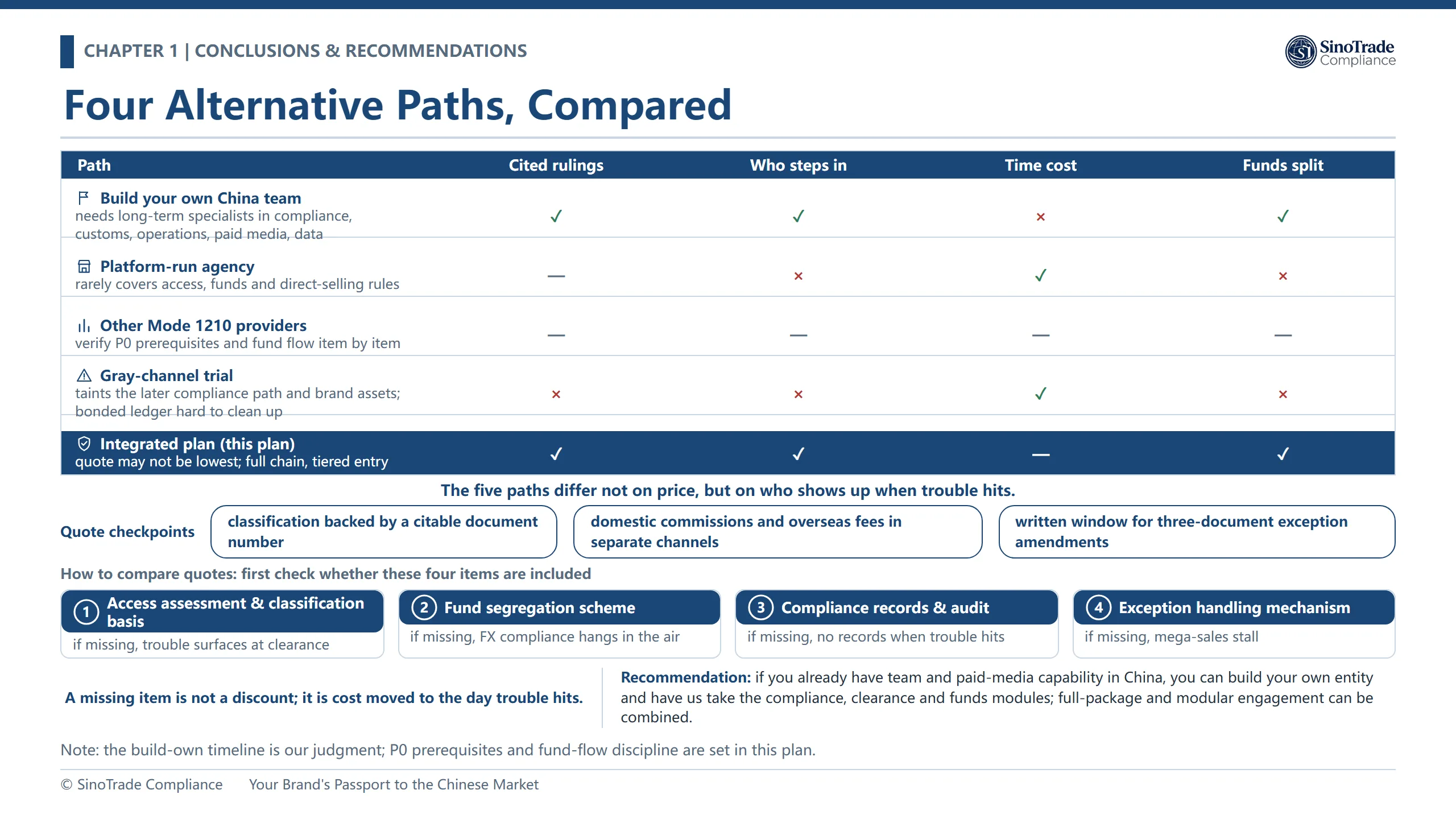
Five routes, one table
The comparison uses four dimensions: classification basis, who shows up when trouble hits, time cost, and fund segregation. Classification basis asks whether the route has a citable document behind it (the regulatory basis is the 1210 framework and the allocation of participant responsibilities established by Announcement No. 486); who shows up asks whether a lawful entity steps in when trouble hits; time cost asks how long from kickoff to first orders; fund segregation asks whether domestic commissions and overseas fees travel in separate channels.
| Route | Classification basis | Who shows up | Time cost | Fund segregation |
|---|---|---|---|---|
| Own China team | Yes, citable document number | Your own team | High: five specialist roles long-term | Segregated, you manage it |
| Platform-run agency | Rarely provided | No one | Fast | Not segregated |
| Other Mode 1210 providers | Verify item by item | Verify item by item | Verify item by item | Verify item by item |
| Gray channel | None | No lawful entity can step in | Fast | Not segregated |
| Integrated plan (this plan) | Yes, citable document number | Us | Tiered | Segregated, built into the plan |
Read the table row by row, but watch the empty cells: the missing classification cell is the one that surfaces at clearance; the missing fund-segregation cell is the one where FX compliance hangs in the air. The five routes differ not on price, but on who shows up when trouble hits.
Own China team: slow because you hire
Building your own team is not wrong; it means keeping five specialist roles on payroll long-term: compliance, customs, operations, paid media, and data. Remove one and a stretch of the process has no owner. That is where the high time cost sits, not in the registration paperwork itself.
So the table scores the own-team time cost as high, judged on the hiring cycle; the prerequisites and fund discipline stay as described, see the modular combination below.
Platform-run agency: fast because the hard parts are skipped
An agency gets your store and traffic running quickly, but three things are largely not covered: market access, funds, and direct-selling rules. Direct selling is a licensed business with the threshold written in the Direct Selling Regulations; the agency will not touch that stretch for you, nor build fund segregation.
Fast is real, and so is the gap. The common ending with an agency: traffic ramps up, clearance or funds jam, and the compliance catch-up takes longer than doing compliance first.
Other Mode 1210 providers: everything is item-by-item verification
That row says verify item by item in all four cells, which means: this provider class has no uniform weakness and no uniform safeguard. Every provider goes through the four checkpoints below, one item at a time. The checklist is ready-made, in the next section.
Gray channel: the discount is booked for later
The gray channel is fast, and the price is written at the back: it taints your later compliance path and brand assets, and the bonded ledger is hard to clean up. Time saved today is booked as cost in the day you go legitimate.
We do not walk through how this route operates; only the conclusion: if someone is pitching this channel to you, show them this paragraph.
Before comparing quotes, check four things
Whichever route you pick, clear four items before comparing quotes. A missing item is not a discount; it is cost moved to the day trouble hits:
- Access assessment and classification basis: the classification needs a citable document number; if missing, trouble surfaces at clearance
- Fund segregation scheme: domestic commissions and overseas fees in separate channels; if missing, FX compliance hangs in the air
- Compliance records and audit: records must be retrievable for review; if missing, nothing to show when trouble hits
- Exception handling mechanism: three-document amendments need a written window; if missing, order changes jam during mega-sales
The written window deserves its own sentence. Under Announcement No. 194, cross-border retail import runs on a three-document match where order and payment push first and logistics writes back; during mega-sales, volume spikes, and without a pre-agreed written window for exception amendments, an order change becomes a clearance incident.
Run the checkpoints through a real scenario: two quotes, A lower than B, but A gives no classification document and no sub-channel for funds; B has both. After the four checkpoints, what A saves is the demurrage and delisting losses of the clearance jam, not a discount.
Modular combination, not either-or
Full-package and own-team can combine: if you already have a team and paid-media capability in China, build your own entity and hand us the compliance, clearance, and funds modules; full-package and modular engagement can be combined, filling whatever you lack.
Scope note: the own-team timeline is our judgment, premised on the P0 prerequisites and fund discipline as set; the quote may not be the lowest on the market, in exchange for the full chain and tiered entry.
If you are comparing entry routes, send us the quotes you already hold; we will run them through the four checkpoints and tell you which items are present, and where each missing one will surface. Contact us, and tell us your products and where you stand.