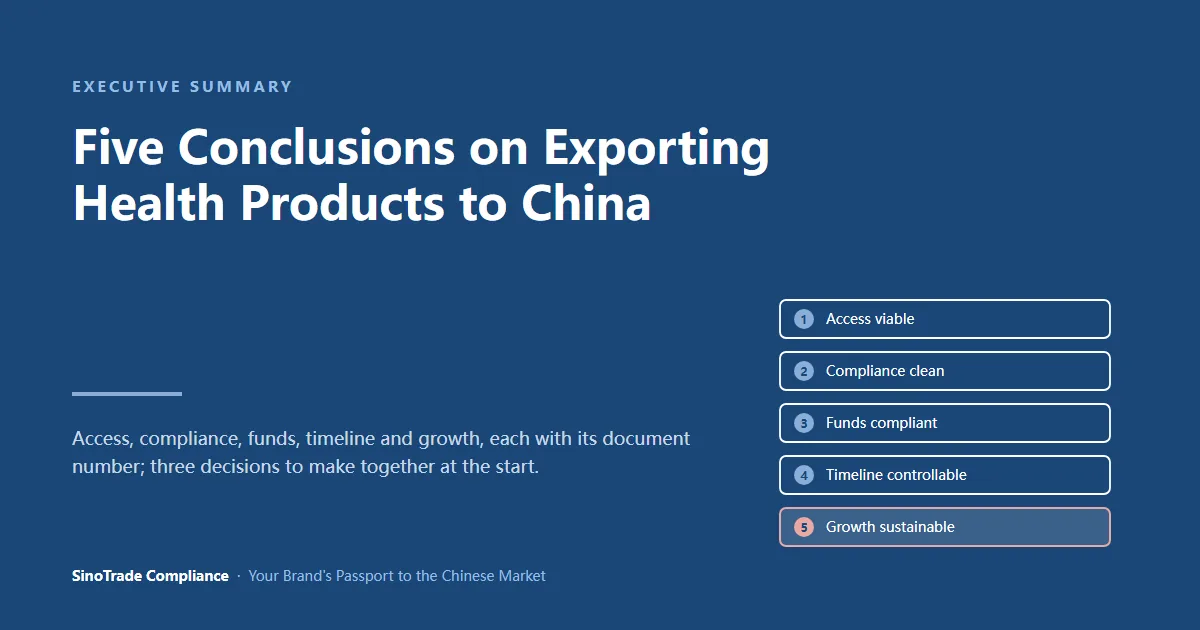
To finish the verdict for a health product category exported to China, the questions come down to five: can it get in, is it compliant, how does the money travel, how long does it take, and how does it grow afterwards. Over the years many brands have brought me exactly these five questions, and the answers have held remarkably steady, so we shaped them into five conclusions given in one pass, each with its document number; beyond the conclusions, what we need to settle with you at the start comes down to three decisions.
Giving conclusions first is not skipping the argument. We have walked this verdict path in full more than once on live projects: classification, list, tax, supervision, funds and schedule each have a basis you can check, and the body lists the source behind every conclusion. When you finish this piece you hold five conclusions with sources, four key numbers and a list of three decisions for the start, enough to carry an internal decision meeting.
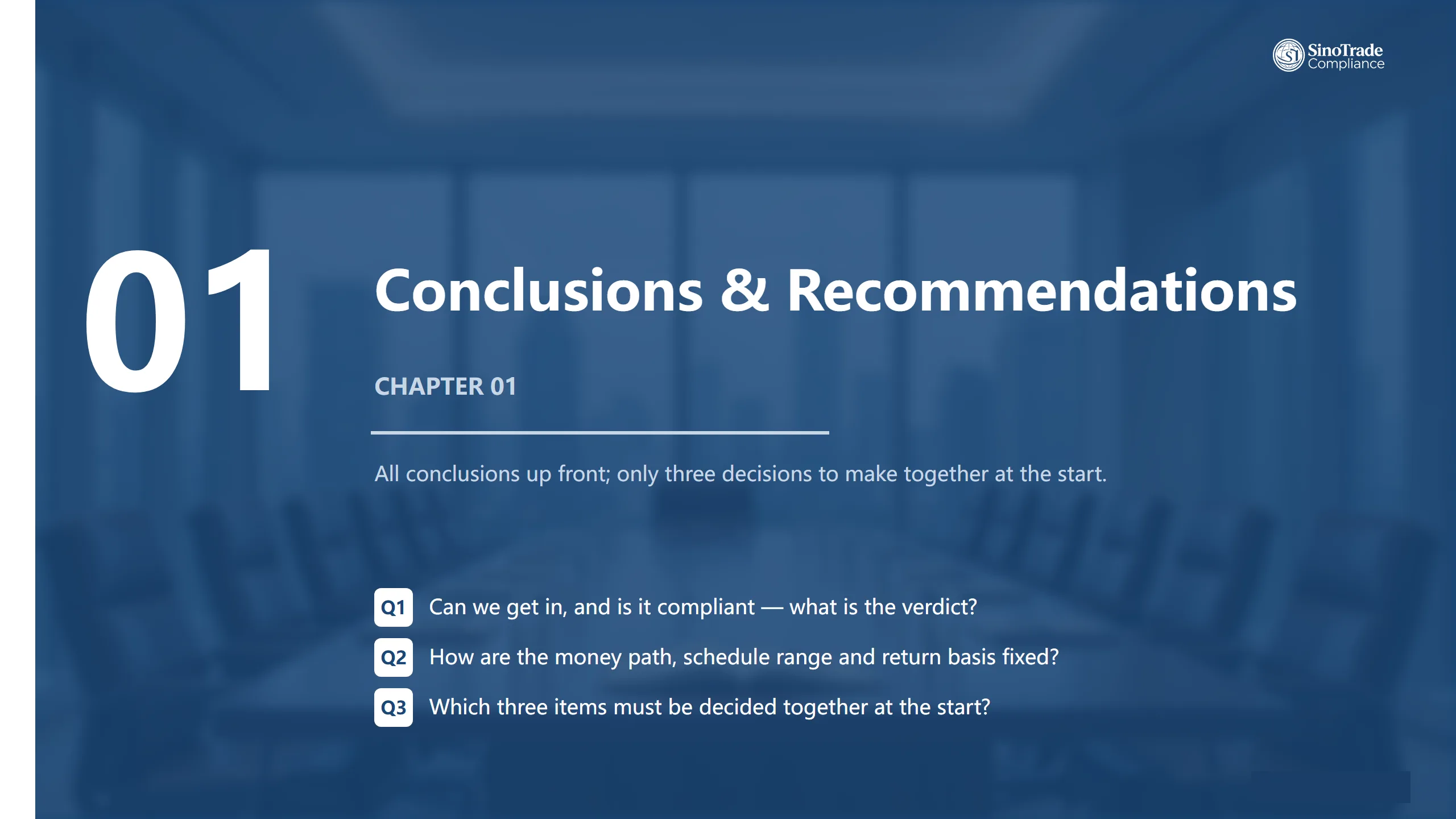
Three questions, aimed first
Hold off on the policy documents for a moment. What you are judging gathers into three questions; with the target set, the conclusions have a place to land:
- Whether access and compliance can be established, and what the verdict is;
- How the money path, the schedule range and the return basis are fixed;
- Which three items must be decided together at the start.
The first two questions are answered by the first four of the five conclusions; the third is answered in the section on the start. You can look at where the three questions sit on the figure, then take the conclusions one by one.
Five conclusions, each with its source
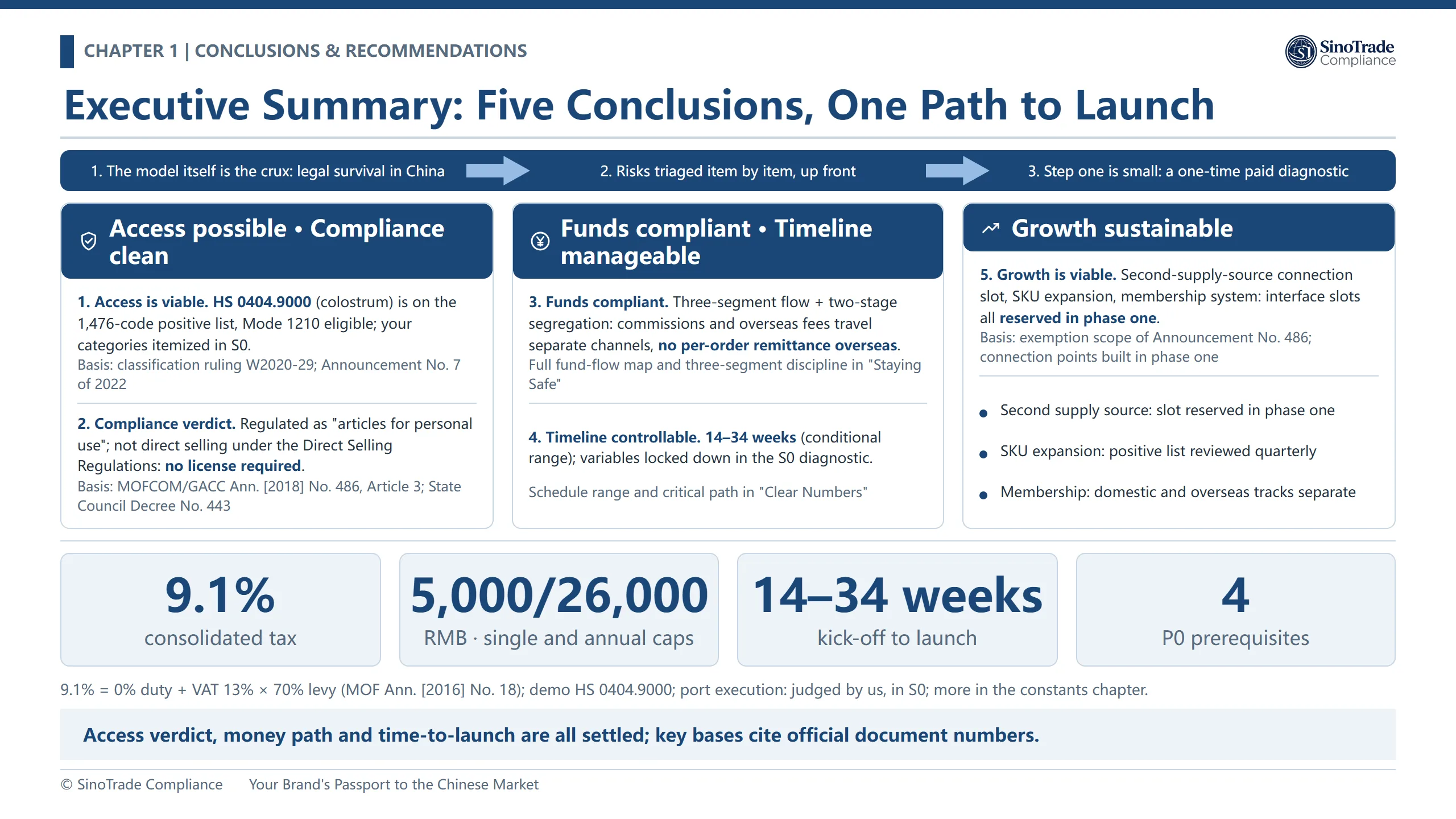
The five conclusions run from getting in, to money, to growth. Each ends with its basis, and you can check the document numbers yourself:
- Access is viable: whey protein powder classifies under HS code 0404.9000, inside the 1476 eight-digit codes of the positive list, and runs through the Mode 1210 bonded cross-border e-commerce channel. Basis: classification ruling W2020-29; Announcement No. 7 of 2022 of eight departments. The example code demonstrates the verdict path; your actual categories are classified item by item in the S0 diagnostic.
- Compliance is established: regulated as articles for personal use, without first-import permits, registration or filing requirements, and not direct selling under the Direct Selling Regulations, so no direct-selling license is needed (per State Council Decree No. 443, the Direct Selling Regulations). It also pays to know where the exemption ends: product quality liability, advertising claim boundaries and consumer protection are the three items not covered. Order No. 280, effective 1 June 2026, governs general trade imports and does not change this channel. Basis: Announcement No. 486 of 2018 of six departments.
- Funds are compliant: a three-segment money flow plus two-stage segregation; onshore commissions and overseas fees travel on separate channels, with no per-order remittance overseas. Basis: the supervision design that matches order, payment and logistics records (GACC Announcement No. 194 of 2018); the money path is built on the same basis.
- The timeline is controllable: 14 to 34 weeks from kick-off to launch, a conditional range. Diagnostic 2 to 4 weeks, single-SKU pilot 6 to 10 weeks, scale-up by module; the range holds when the variables are locked down in the diagnostic.
- Growth is viable: a second-supply-source slot, quarterly expansion of in-list SKUs, and membership tracks kept separate onshore and overseas, all with interface slots reserved in phase one, enabled in phase two without rebuilding. Basis: the list scope of Announcement No. 7 of 2022 sets the expansion boundary; the slots are built at the entity and warehousing stages.
The five conclusions and the four key numbers sit on one page, each source labeled; you can treat it as the table of contents of this piece.
Four key numbers, and that is enough
- 9.1%: customs duty temporarily set at zero, VAT charged at 70% of the statutory amount, 13% × 70% = 9.1%, per Cai Guan Shui [2016] No. 18. The rate applies only to in-list goods within the limits.
- 5000 and 26000: 5000 yuan per single order (about 700 US dollars), 26000 yuan per person per year (about 3,600 US dollars), per Cai Guan Shui [2018] No. 49. The quota is deducted order by order at clearance, and the consumer can see every deduction in the official mobile channels.
- 14 to 34 weeks: diagnostic 2 to 4 weeks, single-SKU pilot 6 to 10 weeks, scale-up with eight modules enabled in order. The range is conditional, and the conditions are locked in the diagnostic.
- Three prerequisites: the category is on the positive list, the buyer is an individual for personal use, and the order is within the limits. If any one fails, solve access first and do not start the pilot.
Each number governs one thing: the rate governs cost, the quota governs volume, the timeline governs scheduling, the prerequisites govern the start. Get these four across and every later stage stays on the same basis.
One concrete calculation
Take one can of whey protein powder priced at 50 US dollars: converted at 7.2 yuan per dollar it is about 360 yuan, within the single-order limit; the consolidated tax is 360 × 9.1% = 32.8 yuan, about 4.5 US dollars, withheld and remitted by the platform; the buyer's annual quota is drawn down by 360 yuan. The tax is legally the consumer's duty, but it lands in the retail price, and pricing must include this layer from day one; in quote reviews, this layer is the most common omission.
The same example works as a threshold. If the category is not on the positive list, or a single indivisible item exceeds the limit, the consolidated rate and the quota deduction no longer apply and the order falls back to full general-trade taxation. The three prerequisites are not a formality; they decide which tariff regime your goods face, and how you quote when you negotiate.
Only three decisions at the start
The answer to the third question is three items, and the order is the dependency order; we have seen the price of running it in the wrong order:
- Whether to start the paid S0 diagnostic. Two to four weeks yields four reports that decide whether and how to enter; without this decision, access tiering and a precise schedule never appear.
- The onshore entity path. Wholly foreign-owned, a joint venture, or a transitional arrangement with the platform as the onshore entity; decided before entity setup, it directly affects the store and the fund accounts.
- The food category positioning. Ordinary food carries no blue hat registration and allows no health claims; a blue hat health food allows function claims at a higher recurring cost; decided before product filing, it determines the category and the launch date.
Three more items to confirm along the way: the preferred port, the billing method for the commercial stage, and whether the second supply source enters phase two. None of the three blocks the start, but they shape the quote and the schedule.
How conclusions become evidence
The five conclusions are not verbal verdicts; every stage has an acceptance deliverable that pins them down. Access and compliance are pinned in the diagnostic stage by four reports: the access report lands the codes, the list and the supervision conditions on the concrete category, the compliance report attaches a document number to every conclusion, the execution checklist schedules the sequence and the materials by week, and the port-standards checklist matches actual practice at the target port. Take these four reports into your internal meeting and the bases are all on paper; you should not need to come back and ask.
Funds and timeline are verified in the single-SKU pilot by the first shipment: the three records matching proves the money path, and the first order's lead time landing inside the range proves the scheduling standard. Growth is cashed in the scale stage through the interface slots, with the second supply source and the expansion channels given their slots in phase one.
What these five conclusions do not cover
The framework governs the verdict, not the choice. There are four questions it does not answer, and you will need to decide them against your own circumstances:
- Pricing and channels: which platform, which price band, how to schedule promotions;
- The equity and tax structure of the onshore entity;
- Category-specific access verdicts: every code must be checked against the list and the supervision conditions separately; the example code does not replace item-by-item classification;
- The registration-path trade-off: blue hat, bonded or general trade, depending on category, ingredients and budget.
The conclusions answer the result and the basis of the verdict; they do not replace tax or legal advice, nor the item-by-category access check.
Why move now
Brands that enter with compliance first lock three things later entrants find harder to get: the ledger and port filing slots in the comprehensive bonded zone, the trust-and-transaction position in the same platform category, and the ingredient awareness of the core audience. One step later, the thresholds are the same thresholds; only the queue is longer.
Wait when you should. If any of the three prerequisites fails, solve access first and do not start the pilot; when all three hold, the cost of delay usually exceeds the diagnostic fee. Among the waste we have seen, wrong verdicts are rare; the most common is a verdict without action, handing the window to faster competitors.
The five conclusions answer whether it can be done; the three decisions answer where to start; only when both land in the same decision has the project started. If you are weighing a category for China, we can first run a free compliance assessment and lay out the category, the codes, the target channel and the work packages in one table, then decide where to start. Contact us with your product and planned launch timing.