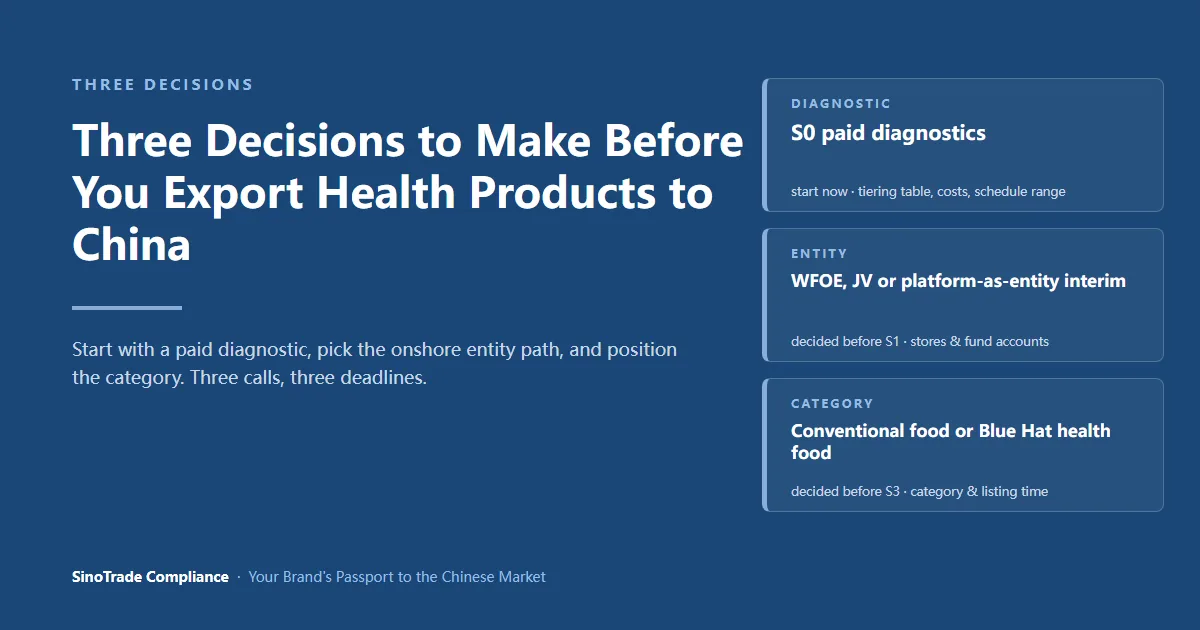
Many brands treat the first step into China as a freight-rate comparison: compare quotes, pick a forwarder, start shipping. After years of handling China compliance cases, here is our opening note: freight and clearance are surface work, and almost any forwarder can quote them. What actually decides whether this model can operate legally in China, and scale, is the set of three decisions you make before work starts. All three are yours to make.
One piece of background first: S0 through S13 are the fourteen work packages that run through this service. S0 is the paid diagnostic before work starts, producing three decision inputs: an access tiering table, a cost breakdown and a schedule range. From S1 onward the work runs stage by stage. The deadlines below are all anchored to when a given package starts.
Three decisions, each with a deadline
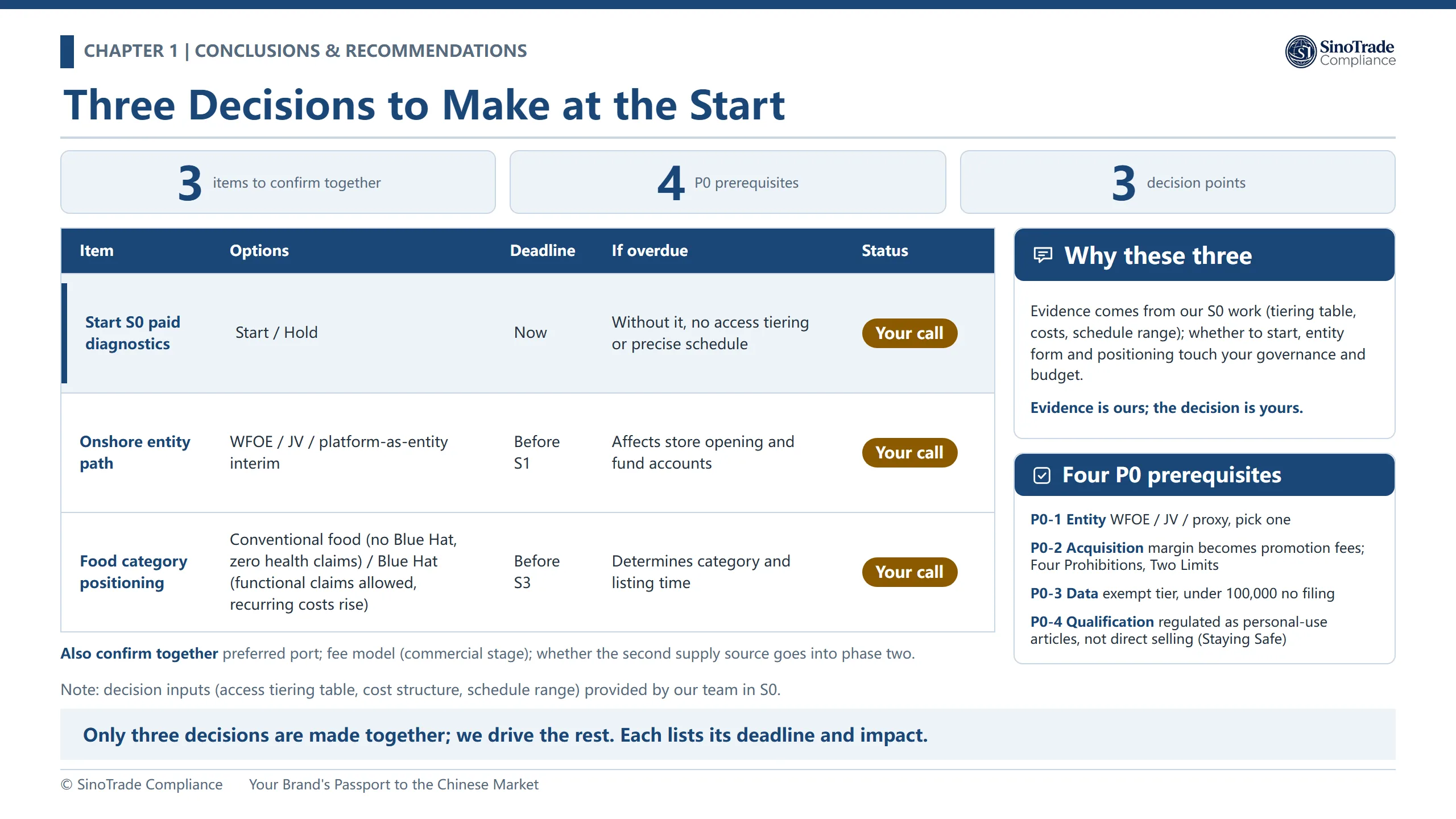
| Decision | Options | Deadline | If it slips |
|---|---|---|---|
| Start the S0 paid diagnostic | Start / hold | Now | No access tiering and no precise schedule without it |
| Onshore entity path | WFOE, JV or platform-as-entity interim | Before S1 | Affects store opening and fund accounts |
| Category positioning | Conventional food (no Blue Hat, zero health claims) or Blue Hat health food (claims allowed, cycle and cost rise) | Before S3 | Determines category and listing time |
A few more items get confirmed in the same meeting, without separate line items: preferred port, the fee model at the commercial stage, and whether the second supply source goes into phase two.
Why only these three are made together
The test is a single question: does the decision touch your governance and budget, rather than execution detail? Whether to start the diagnostic decides whether the project runs at all; the entity form decides how money comes in and under whose name the stores open; category positioning decides what identity your product sells under and what you may say. Once these three are set, driving all fourteen work packages is our job.
The decision inputs come from us in S0: the access tiering table rules on which channel each of your SKUs takes, the cost breakdown spreads the compliance work into line items, and the schedule range gives the time span of every step. The evidence is ours; the decisions are yours.
Four prerequisites before work starts
Besides the three decisions, four things get locked in at fixed terms during the starting phase. You do not decide them one by one, but you should know they exist:
- Pick one entity form. WFOE, JV or platform-as-entity interim each has trade-offs; S1 entity setup starts only after the choice is made.
- Promotion income: margin becomes service fees. Reseller-margin-style promotion income is unstable under China's licensing context; switch to a promotion service fee basis, landed per the Four Prohibitions and Two Limits, to stay clear of pyramid-scheme qualification risk.
- Data export takes the exempt tier. Scenarios with fewer than 100,000 individuals provided abroad cumulatively do not trigger filing obligations; in phase one, staying inside this tier keeps the data chain simplest.
- Qualification basis: regulated as personal-use inbound articles, not direct selling. The Direct Selling Regulations (State Council Decree No. 443) govern the model of recruiting salespeople and team-based pay; the regulatory basis of 1210 retail imports does not fall into that frame. This is a characterization to state at the very start.
The real decision is model and architecture, not freight
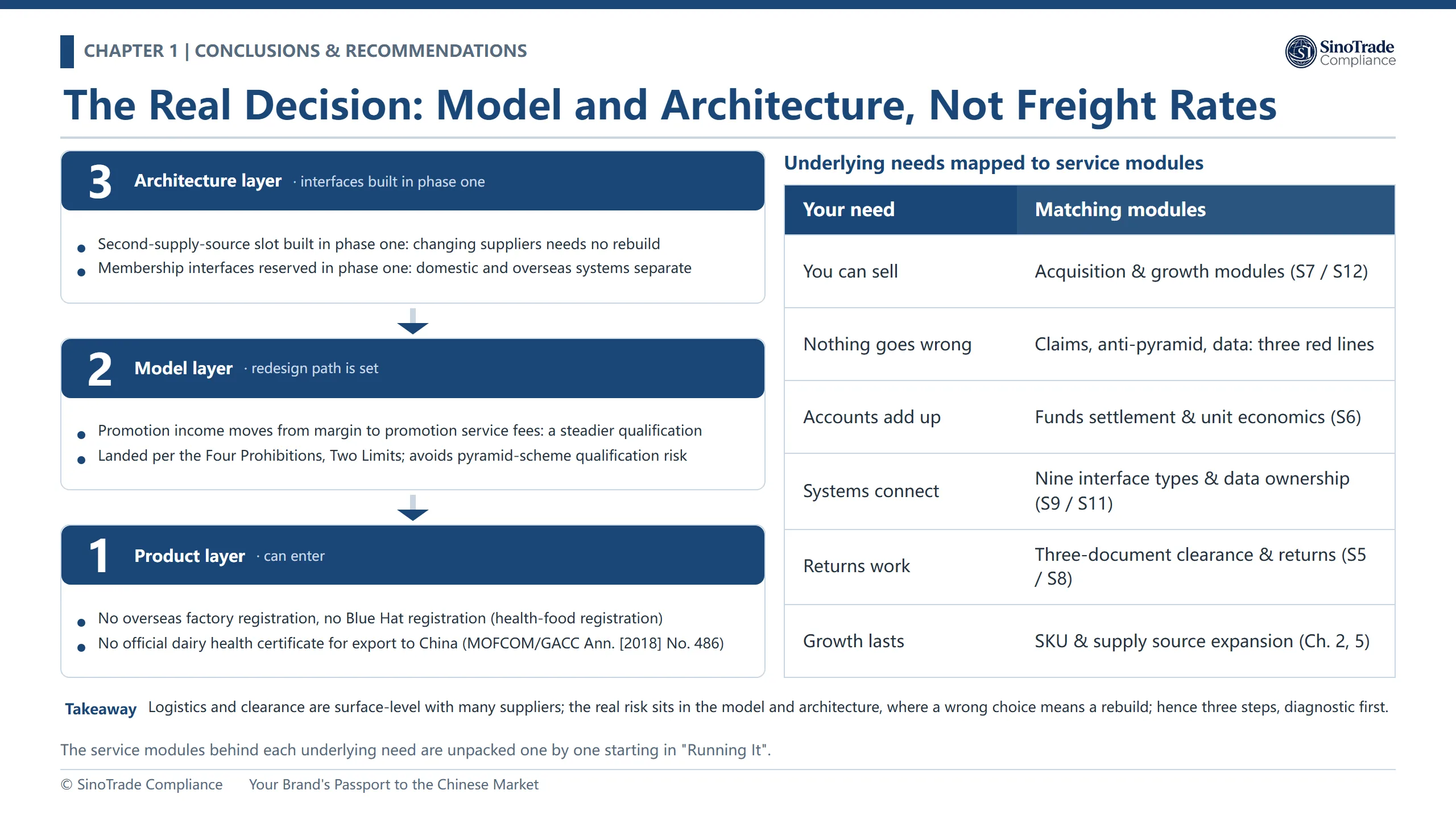
Read the whole entry plan as three layers, top down: architecture, model, product.
Product layer: can you enter? Usually yes. Under Article 3 of Announcement No. 486 [2018], goods under 1210 are regulated as personal-use inbound articles: first-import licence, registration and filing do not apply. No overseas factory registration, no Blue Hat health-food registration, and dairy is exempt from the official health certificate. At this layer, the bonded route has removed the threshold for you.
Model layer: how do you take money, compliantly? Promotion income moves from reseller margin to promotion service fees, landed per the Four Prohibitions and Two Limits. Set this basis when work starts and you never have to rework it; the qualification risk is retired here once, not patched after problems show up.
Architecture layer: which interfaces must be built in phase one? Two things must be in place in phase one: the slot for a second supply source (switching suppliers later needs no rebuild) and the reserved membership interface (domestic and overseas systems stay separate, so each can evolve without dragging the other). Architecture mistakes are the most expensive; a wrong choice means a rebuild, and this is the only layer where rework costs approach starting over.
Logistics and clearance are surface work that many suppliers can do; the real risk sits in model and architecture. That is why the entry rhythm is fixed at three steps, diagnostic first.
Six underlying needs and the modules behind them
Every module in the plan answers one of six underlying needs (S0–S13 are the fourteen work packages of the service):
| Your need | Matching modules |
|---|---|
| You can sell | Acquisition and growth modules (S7, S12) |
| Nothing goes wrong | Claims, anti-pyramid and data: three red lines |
| Accounts add up | Funds settlement and unit economics (S6) |
| Systems connect | Nine interface types and data ownership (S9, S11) |
| Returns work | Three-document clearance and returns (S5, S8) |
| Growth lasts | SKU and second-supply-source expansion (Chapter 2, Chapter 5) |
The point of this table is reverse lookup: at any stage, when something feels off, you can trace the need to the work package that owns it instead of rereading the whole plan.
How the three decisions actually get made
Take a typical New Zealand health-product brand: the first decision meeting runs 45 minutes, and all three rows get filled on the spot.
Row one, whether to start S0. This row barely needs debate: without the diagnostic there is no tiering table, and every later discussion hangs in the air. The call is made on the spot, and the schedule takes effect that week.
Row two, the onshore entity path. This row depends on the shareholder structure: if a Chinese partner is in talks, plan for a JV with a WFOE fallback; if not, the platform-as-entity interim is the lowest-cost way to start, to be finalized before S1.
Row three, category positioning. Go through the product line one by one: items running as conventional food go straight into phase one; those that want function claims move to phase two, when the cycle and cost of Blue Hat registration can be assessed. For any SKU you cannot settle, default to conventional food and exclude every function statement.
After the meeting you hold three written confirmations, and we hold the go signal. That is the whole mechanics of the three decisions: you do not need the details of Chinese regulation, only to make the call against the options before the deadline.
What this article does not cover
- Execution detail of the work packages. How each of the fourteen packages runs and what it delivers belongs to the service execution layer; this article gives only the decision frame for three decisions and the mapping of six needs.
- Product-level category judgment. The difference between conventional food and Blue Hat in claims and cycle, applied to a specific SKU, needs a separate analysis of ingredients and product form.
- Tax and quotas. The consolidated tax and annual quota of retail imports are a separate topic, parallel to these three decisions, and are not covered here.
- Freight and clearance comparisons. Surface matters, outside the decision frame.
If you are preparing to enter the Chinese market, Contact us for a free compliance assessment. Send us your product line and where you stand, and we will frame the three decisions for you: the options, the deadlines and what is blocking each one today.